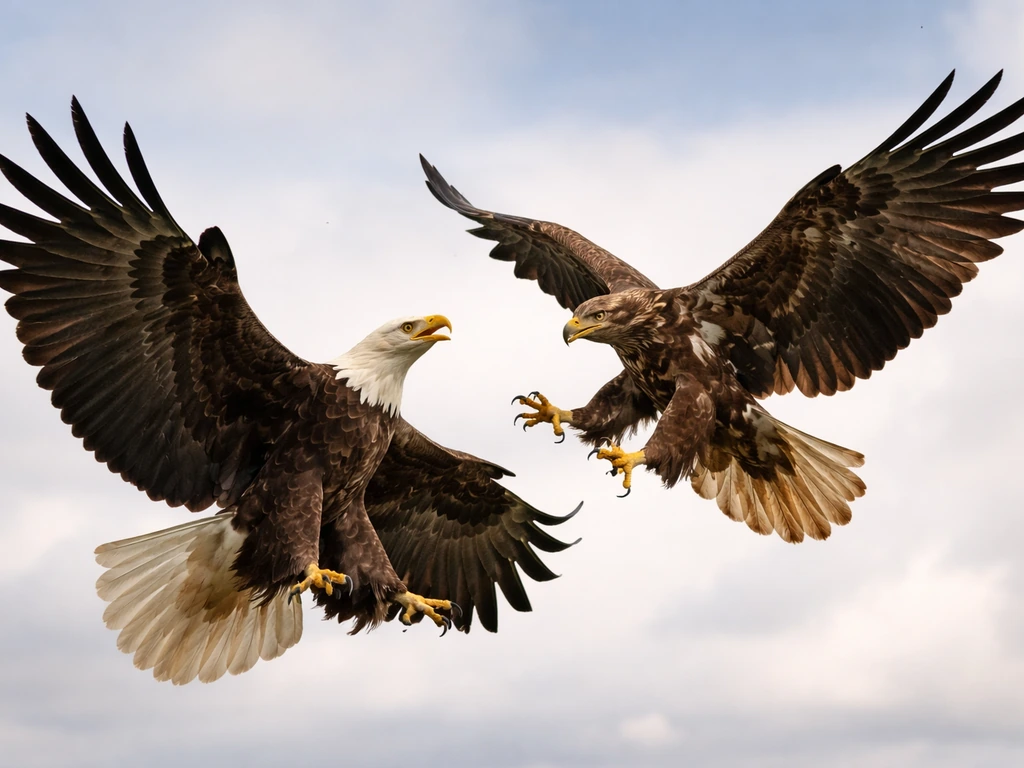
Do only one bird attack eagles? The short answer
No, and this is probably the most persistent myth in casual bird conversation. The idea that there is "the only bird that will attack an eagle" is not supported by documented behavior. Multiple bird species, particularly other raptors, regularly attack, mob, or harass eagles in the wild. The real picture is messier and more interesting than a single nemesis species.
Cornell Lab's Birds of the World puts it plainly: "Many other species also may attack eagles." That phrasing is significant. It is not a rare exception, and it is certainly not limited to one bird. If you have heard the claim that only one species dares to attack an eagle, that claim is folklore, not ornithology.
The birds most likely to attack an eagle (raptor vs. raptor)
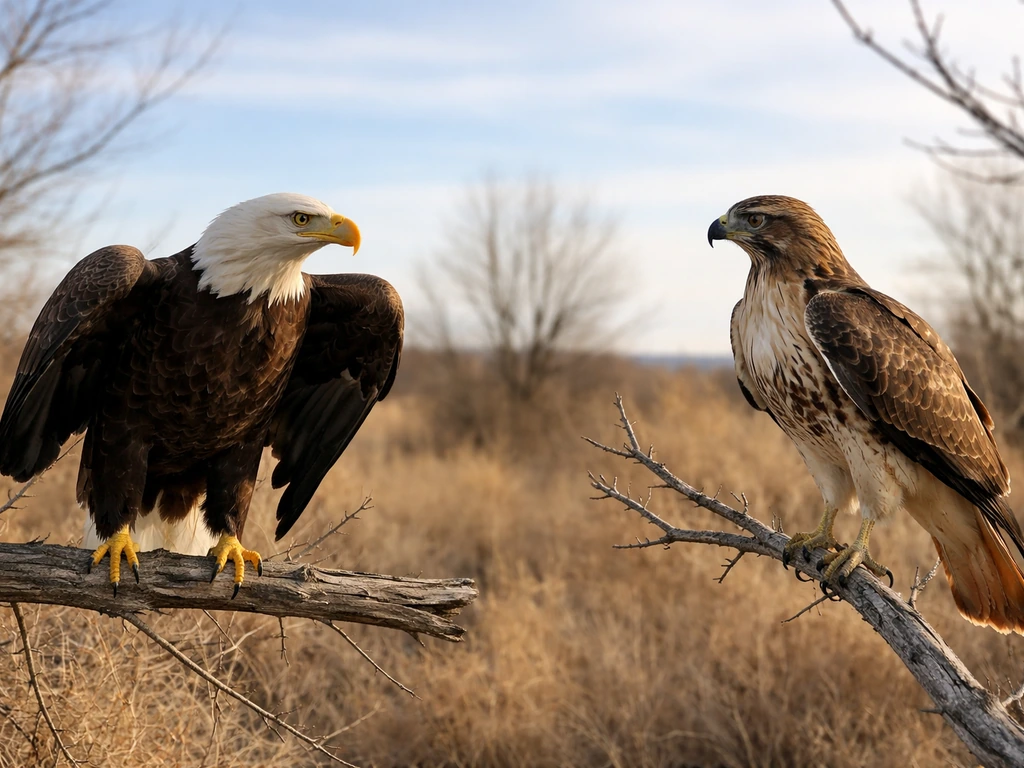
The attackers that show up most consistently in the literature are other raptors. Red-tailed Hawks are probably the most documented aggressors. Birds of the World specifically notes that both blank" rel="noopener noreferrer">Golden Eagles and Bald Eagles are "regularly harassed, chased, and attacked, especially near Red-tail nests." That last phrase matters: location relative to a nest is a major driver of these interactions.
The USFWS lists several raptor species known for aggressive behavior toward other large birds during nesting season: Red-tailed Hawks, Red-shouldered Hawks, Cooper's Hawks, Swainson's Hawks, Northern Goshawks, Broad-winged Hawks, and Peregrine Falcons. Any of these can and do go after eagles when circumstances call for it. The Peregrine Falcon in particular is fast and fearless enough to land real strikes on a much larger bird.
Corvids, especially Common Ravens and American Crows, also mob eagles frequently. They rarely injure eagles, but they are persistent and can disrupt feeding, rest, and nesting. The Raptor Resource Project documents "intrusions" near bald eagle nests by a range of species, with Red-tailed Hawks specifically called out as a common intruder in or around eagle nesting areas.
It is also worth knowing that eagles attack each other. Intraspecific aggression (same-species conflict) over nest sites and territory is well-documented and can be more dangerous to an eagle than anything a smaller bird does. When thinking about what bird attacks other birds in a territorial context, eagles themselves are on both sides of that equation.
When attacks are most likely: nests, competition, and vulnerable eagles
Nesting season is peak conflict time
The window roughly runs from January through August, though it varies by region and species. During this period, raptors are defending eggs and chicks and are highly motivated to drive off anything that comes close, including an eagle that wanders into the wrong airspace. USFWS guidance specifically flags this season as the period when aggressive raptor behavior spikes significantly.
Territory and food competition
Outside of nesting season, attacks are more likely to be about food. Eagles are kleptoparasites, meaning they steal prey from other birds, so a Red-tailed Hawk that just caught a rabbit has a real reason to drive off an eagle that is eyeing that meal. This kind of pursuit is common and can look dramatic, but it is typically short and does not result in injury to either bird.
Juvenile eagles are at higher risk
Young eagles, especially those in their first and second years, lack the flight experience and social signals of adults. They are more likely to drift into occupied territories by accident and less capable of reading the warning signals other raptors send before escalating to a physical attack. If you observe an attack, the target is more likely to be an immature bird than a full adult.
Predation vs. harassment vs. scavenging: how to tell them apart
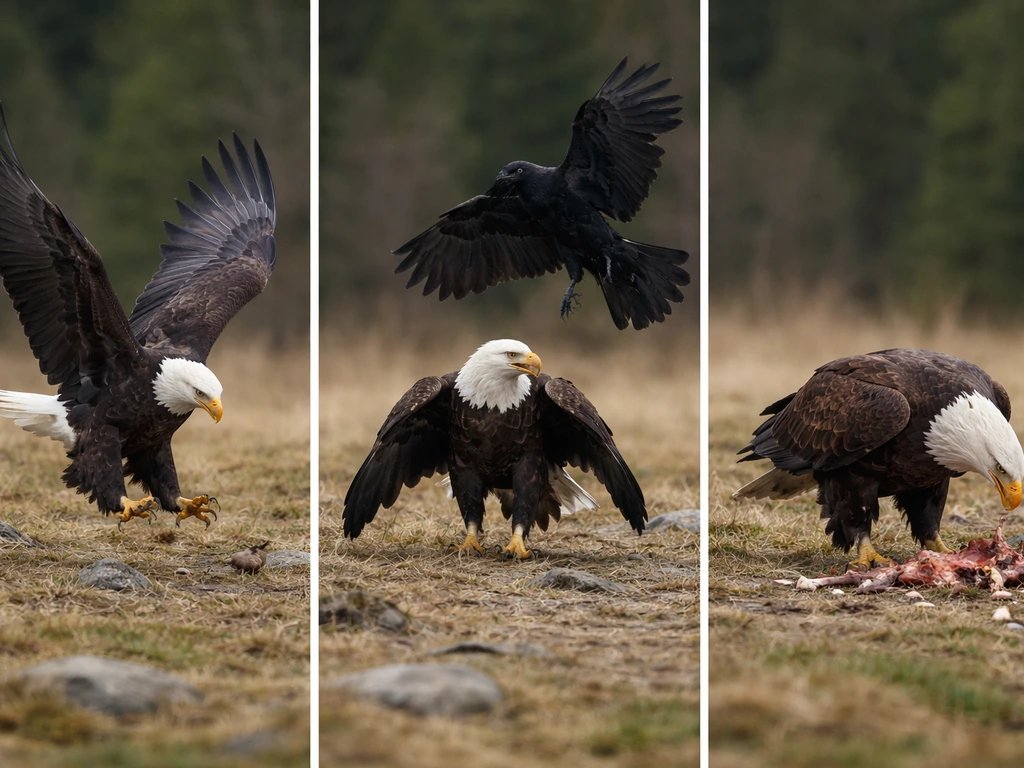
These three things look very different once you know what to watch for. Getting this right matters if you are trying to report what you saw or understand what actually happened.
| Behavior type | What it looks like | Likely outcome for the eagle |
|---|
| Harassment / mobbing | Smaller bird dives repeatedly at the eagle, calling loudly; eagle keeps flying or eventually leaves the area | No injury; eagle moves on |
| Predation attempt | Sustained pursuit, physical contact, targeting of vulnerable body parts; often aimed at nestlings or injured birds | Possible injury or death, especially for nestlings |
| Kleptoparasitism | Eagle chased immediately after catching prey; attacker breaks off once eagle drops or escapes with the food | Eagle loses a meal, no injury |
| Scavenging | Smaller bird feeds on an eagle carcass already on the ground; no pursuit or aggression involved | Eagle was already dead before the bird arrived |
Scavenging is the one most people misread. Finding a crow or raven feeding on a dead eagle does not mean that bird killed the eagle. Ravens and crows are opportunistic feeders. Unless you witnessed the actual attack and death, do not assume the bird eating the carcass is the culprit.
The behaviors above overlap somewhat with the reasons what bird attacks humans gets asked so often. People often see dramatic aerial conflict and assume the worst, when most of it is territorial signaling that stops well short of serious injury.
What to do if you suspect an eagle attack (practical steps for today)
- Stay at a safe distance. USFWS uses a 1-mile radius around bald eagle nests as an important proximity threshold in their monitoring guidelines. If you are closer than that during nesting season, you are in a zone where any disturbed raptor, not just the eagle, may act defensively toward you as well.
- Note the species if you can. Even a rough description, large brown hawk, small falcon with a barred chest, helps wildlife authorities identify what you saw. Take photos or video from a distance if it is safe to do so.
- Record the timing and location. When attacks happen relative to the nesting season, and where they occur relative to visible nest structures, is exactly the information wildlife managers need.
- Note the target's age if possible. Dark eyes and streaked, brown-mottled plumage usually indicate a juvenile eagle. Adults have the well-known white head and tail (Bald Eagles) or solid dark brown with golden neck feathers (Golden Eagles).
- Contact your state wildlife agency or the USFWS if you find an injured or dead eagle. Bald and Golden Eagles are both federally protected under the Bald and Golden Eagle Protection Act, so handling or approaching a downed eagle without authorization is illegal.
- Do not intervene physically. Do not attempt to chase off attacking birds, pick up injured eagles, or disturb nest sites. Call the professionals.
If you are watching raptors near a pigeon colony or a mixed bird area and wondering how to interpret the behavior you are seeing, it helps to understand that the same territorial logic applies across species. The question of what bird attacks pigeons follows similar patterns: raptors attack when they are hungry or feel threatened, not because of any single fixed grudge.
Myths worth clearing up
"Only one bird will attack an eagle"
This is the core myth this article exists to correct. It is false. At minimum, Red-tailed Hawks, Peregrine Falcons, Northern Goshawks, Red-shouldered Hawks, Cooper's Hawks, Broad-winged Hawks, Swainson's Hawks, Common Ravens, and American Crows are all documented as birds that attack or harass eagles. The "only one" framing probably comes from the dramatic nature of certain encounters being shared on social media or passed through informal wildlife conversation, but it does not reflect the science.
"Eagles always win"
Size and power do not guarantee victory in a surprise attack, especially for a young or injured eagle. A Peregrine Falcon, the fastest animal on Earth in a dive, can strike a large raptor before it has time to react. Persistent mobbing by corvids can exhaust a bird or drive it from critical territory. Eagles are apex predators in many ecosystems, but they are not invincible.
"If a bird is diving at an eagle, it is going to kill it"
Most diving and chasing behavior is harassment designed to move the eagle out of an area, not kill it. The goal is displacement, not predation. The same principle applies when you look at why would a bird attack a human: the motivation is almost always "get this threat to leave" rather than genuine predatory intent. Understanding that distinction changes how you interpret what you are watching.
"Only small birds mob; large raptors don't bother"
Large raptors mob each other constantly. This is thoroughly documented. A Red-tailed Hawk is a large, powerful bird in its own right, and it regularly drives off Bald Eagles many times its mass. Mobbing is not a small-bird strategy; it is a widespread behavioral tool used across the raptor family.
"Attacks near humans are random"
They are not. Both the timing (nesting season) and the location (near nest sites) are highly predictable. If you understand those two variables, you can anticipate where and when you are most likely to witness or be peripherally involved in raptor conflict. This predictability is also why why bird attack human questions peak during the same January-to-August nesting window: the same nesting-season aggression that drives raptors to attack eagles also makes them more likely to act defensively toward people who get too close.
A note on risk to people who observe these events
If you are near an eagle nest and witness a raptor attack, your own safety is a real consideration. Any large, agitated raptor, eagle or attacker, may redirect aggression toward a person who is perceived as too close. Talons from a hawk or eagle can cause real injury. There is a reason wildlife agencies use the language "do not approach" so consistently.
The U. S. Fish & Wildlife Service also notes that activities farther than 660 feet from a bald eagle nest, or half a mile for loud activities such as explosions, are less likely to bother bald eagles enough to cause nest abandonment [do not approach](https://www. fws.
gov/rivers/story/do-i-need-eagle-take-permit). If you are curious about how far this kind of redirected aggression can go, the documented cases of which bird attack human eye are a useful reminder that birds of prey aim for the face and eyes when they do make contact with people.