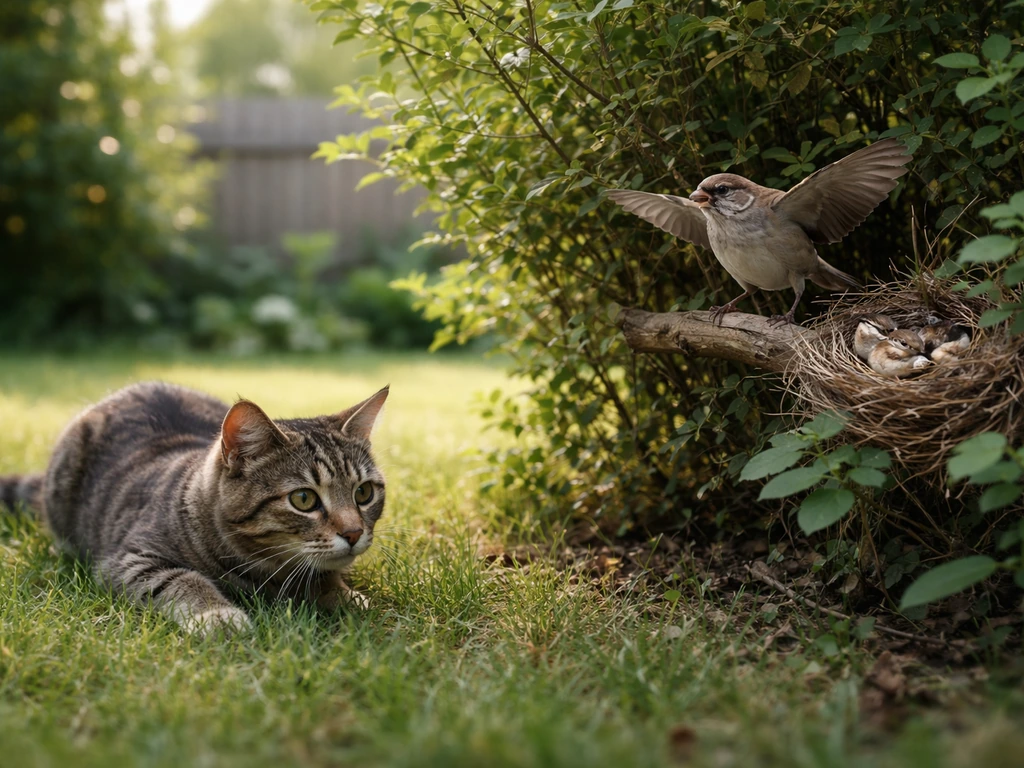
A bird chasing a squirrel in your yard is almost always normal wildlife behavior, not a sign that something is wrong. The bird is defending something it values, usually a nest, a food source, or a claimed patch of territory. Squirrels are opportunistic, and birds know it. What you're watching is a calculated response to a real threat, and in most cases it works exactly as nature intended.
Why Would a Bird Chase a Squirrel? Causes and Next Steps

Maya Chen
17 May 2026
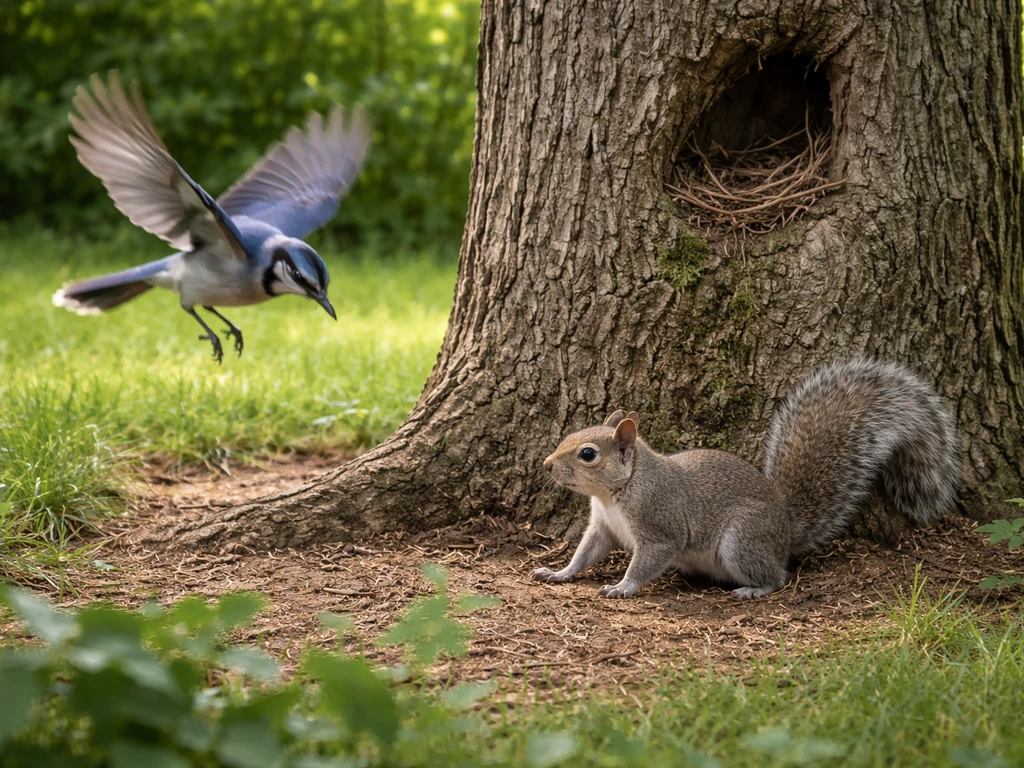
Most likely reasons a bird chases a squirrel
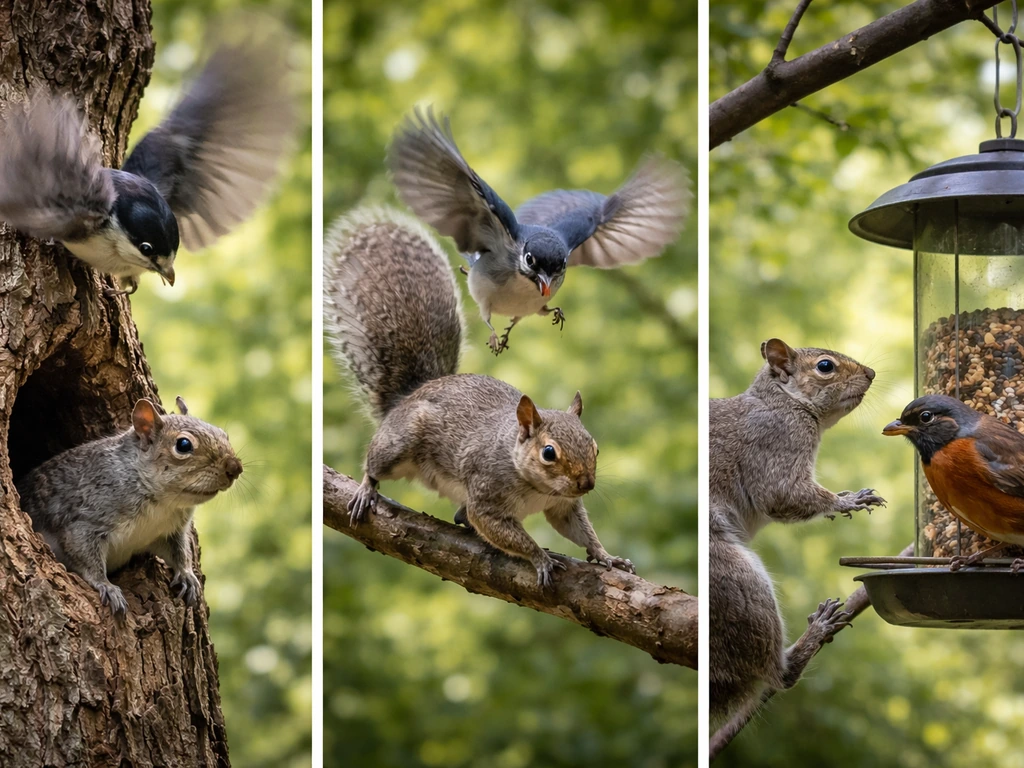
There are four core motivations behind bird-chasing-squirrel behavior, and they often overlap:
- Nest defense: A squirrel wandering too close to an active nest triggers an immediate, aggressive response. Birds are hardwired to protect eggs and chicks from nest predators, and squirrels are documented egg and nestling predators. Flying squirrels in particular are known to raid nest boxes. The bird isn't overreacting; it's doing exactly what millions of years of evolution prepared it to do.
- Food competition at feeders: If you have a bird feeder in your yard, squirrels are almost certainly visiting it. Birds that have claimed a feeding spot will chase off competitors, including squirrels. This is especially common with territorial species like blue jays, mockingbirds, and red-winged blackbirds.
- Mobbing behavior: Smaller birds sometimes band together to harass a larger animal they perceive as a threat. This coordinated chasing, called mobbing, involves loud calls and repeated dive-bombing. It's a group effort to drive a predator or intruder out of the area.
- Learned or habitual defense: Some individual birds, especially mockingbirds and American robins, develop a very low tolerance for specific repeat offenders. If the same squirrel keeps showing up in the same spot, the bird learns to chase it on sight.
Squirrel nest predation on birds is real and well-documented in the scientific literature. Hunger level can influence how aggressively a squirrel pursues eggs or nestlings, which means a bird's aggressive response to a squirrel isn't paranoia. It's pattern recognition.
How to tell if it's territorial defense, nest protection, or food competition
The behavior looks similar on the surface but the context tells you a lot. Here's how to read what you're actually seeing:
| What you observe | Most likely motivation | Key clue |
|---|---|---|
| Bird dives repeatedly at squirrel near a tree cavity, dense shrub, or low branch | Nest protection | Chase radiates outward from a fixed central point; bird returns to same spot after each pass |
| Bird uses a drooping wing or distraction display near the ground | Nest protection (broken wing display) | This is a deliberate distraction tactic used when a nest or young are on or near the ground |
| Bird chases squirrel away from a feeder, then immediately returns to eat | Food/feeder competition | The bird returns to the food source, not a tree or shrub |
| Multiple birds of different species join in, calling loudly | Mobbing a perceived threat | More than one species involved; lots of alarm calls, not just one bird's repetitive dive |
| Bird chases squirrel across the whole yard with no clear home base | General territorial defense | No single defended object; bird is claiming a broader area |
The broken wing display is worth knowing about specifically. If a bird lands near a squirrel and appears to drag one wing along the ground while calling, it's not injured. It's performing a distraction display to pull the squirrel away from a nearby nest. The U.S. Fish and Wildlife Service notes this as a documented nesting-season behavior. The bird is fine. Don't try to rescue it.
What the season and species tell you about what's happening in your yard
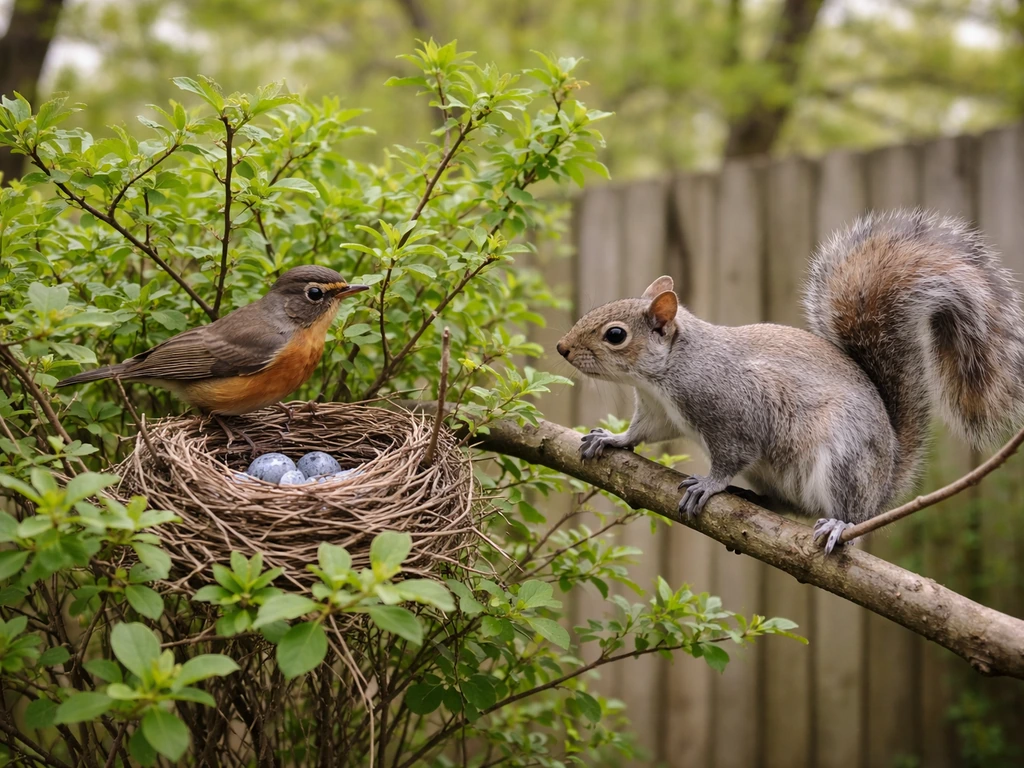
Timing is one of the most useful diagnostic tools you have. Bird aggression toward squirrels peaks during nesting season, which for most backyard species runs from late March through July. According to Mass Audubon, the most intense aggression happens during the nestling period, roughly the two weeks when chicks are in the nest and completely vulnerable. Species that produce multiple broods, like American robins and mockingbirds, can have a second aggressive period in mid to late summer.
Spring is also when hormones surge and birds become territorial before eggs are even laid. All About Birds notes that mobbing is especially common in spring for this reason. If you're seeing intense chasing in April or May, a nest is nearby even if you haven't found it yet.
Species-specific patterns give you additional clues:
- Mockingbirds: famously aggressive year-round, will chase squirrels, cats, dogs, and people without hesitation. Very territorial over feeding areas.
- Blue jays and crows: more likely to mob perceived threats as a group, loud and persistent.
- American robins: most aggressive during the nestling period; will dive-bomb repeatedly if the nest is threatened.
- Red-winged blackbirds: aggressively territorial around nesting areas in wetlands and field edges; will chase almost anything.
- Raptors (hawks, kestrels): less likely to chase squirrels defensively; more likely to be pursuing them as prey. A hawk chasing a squirrel is typically a predation attempt, not nest defense.
If you're seeing a hawk or large bird repeatedly pursuing a squirrel in a direct, focused line (rather than hovering near one spot), you're watching a predator hunt, not a territorial dispute. That's completely normal and not a cause for concern.
Is any of this actually dangerous? Separating real risks from myths
Rabies: clear the confusion up front
One of the most common worries people have when they see unusual wildlife behavior is rabies. Here's what the evidence actually says: birds cannot get rabies. DC Health and the CDC both confirm that rabies is a mammalian disease. Birds, reptiles, fish, and insects are not capable of carrying or transmitting it. So no matter how aggressively a bird is behaving, rabies is not on the table.
The squirrel side of this is also worth addressing directly. The CDC notes that while squirrels are mammals and theoretically capable of rabies infection, no case of a human contracting rabies from a squirrel bite has ever been documented in the United States. DC Health's rabies guidance explicitly states this. Squirrel bites should still be cleaned and evaluated, but aggressive squirrel behavior in your yard is not a rabies red flag.
Real risks worth knowing about
The actual health risks in this scenario are lower-profile but more realistic. Bird feeders can harbor salmonella, and the CDC has investigated salmonella outbreaks linked to wild songbirds at feeders. The risk is to you and your pets if you handle feeders without washing your hands afterward, or if a sick bird is visiting and contaminating the feeder surface. This is a hygiene issue, not an aggression issue, but it's worth mentioning because feeders are often at the center of bird-squirrel conflicts.
If a bird or squirrel bites or scratches you during a close encounter (say, while you're trying to handle an animal you thought was injured), that's a real injury risk. Puncture wounds from animal bites can introduce bacteria and should be cleaned thoroughly and assessed by a healthcare provider. The same applies to any scratch that breaks the skin. But the bird chasing a squirrel across your yard poses essentially zero direct risk to you.
Risk to the animals themselves
In most cases, neither animal gets hurt. Squirrels are fast and not easily caught by songbirds. The chasing is more harassment than combat. The greater real-world risk runs the other direction: squirrels genuinely do raid bird nests and eat eggs and nestlings. The bird's aggression is a legitimate survival response to a documented threat.
What to check right now in your yard
Before you do anything else, spend a few minutes observing from a distance. Note where the chase starts and where the bird returns after each pass. That origin point is almost certainly what the bird is defending. Then check these things:
- Look for a nest: Check the tree, shrub, or structure near where the bird keeps returning. Bird nests are compact, cup-shaped, and often hidden in the fork of a branch or tucked into dense foliage. Squirrel nests (dreys) are larger, looser piles of leaves and twigs, usually higher up in the tree canopy. If you see a compact nest with eggs or chicks in the area where chasing originates, you've found your answer.
- Check your feeders: Is the squirrel visiting a feeder? Look for spilled seed on the ground, damage to the feeder, or a squirrel actively raiding it. Spilled seed on the ground is a major squirrel attractant that many people overlook.
- Look for signs of injury: Is either animal moving oddly, unable to fly or run, or staying in one place longer than normal? A grounded bird that isn't performing a distraction display, or a squirrel that's disoriented, warrants a closer (but hands-off) look.
- Check for a pattern: Has this been happening daily at the same time and place? Recurring behavior in the same location almost always means there's a nest nearby or a feeder that keeps drawing the squirrel back.
Immediate steps to reduce the chasing
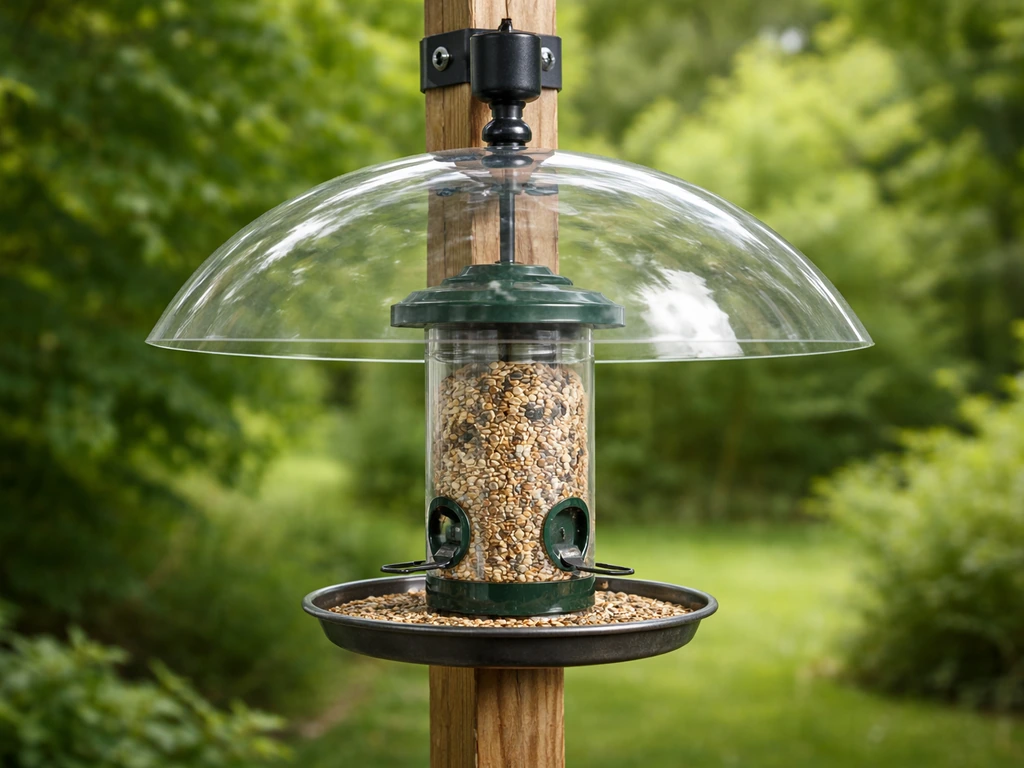
If the chasing is centered on a bird feeder, the most effective single thing you can do is squirrel-proof the feeder. Wild Bird Habitat Store also provides installation guidance noting that baffle placement height and positioning can be key determinants of success. Physical barriers work better than deterrent sprays or relocated feeders alone. Here's what actually helps:
- Install a baffle: A squirrel baffle is a physical barrier, either a dome above the feeder or a cylinder around the pole, that prevents squirrels from climbing up or reaching down to the feeder. Placement height matters: pole-mounted baffles should be at least 4 to 5 feet off the ground, and the feeder should be at least 10 feet from any surface a squirrel can jump from.
- Clean up spilled seed: Seed on the ground is what keeps squirrels coming back even after you baffle the feeder. Use a tray under the feeder to catch shells, or switch to no-mess seed blends that reduce shell debris.
- Switch to squirrel-resistant feeder designs: Tube feeders with cages around them and weight-sensitive feeders that close under heavier animals are effective options. UNL Extension and Michigan wildlife guides both describe these as reliable when properly installed.
- Move the feeder: If possible, position feeders away from tree branches, fences, and structures that give squirrels a launch point. A feeder on a smooth metal pole in an open area with a baffle is much harder to raid.
- Give it time: If the conflict is nest-related, it will usually resolve on its own once the nestlings fledge, typically within two weeks of hatching for most common backyard species. Don't feel pressure to intervene in normal defensive behavior.
If there's an active nest and you're worried about squirrel predation, the best thing you can do is manage attractants (reduce what draws squirrels in) rather than trying to physically protect the nest. Intervening near an active nest can stress the parent birds and cause them to abandon it.
When to actually get help
Most bird-chases-squirrel situations don't need human intervention. But there are specific circumstances where calling a wildlife professional is the right move:
- You see obvious injury: A bird on the ground that isn't doing a distraction display, can't fly when approached, is bleeding, or has a visibly broken wing needs help. Same for a squirrel that's disoriented, circling, or unable to move normally. Don't try to handle either animal with bare hands.
- The aggression is escalating and causing injury to a pet: If a bird (especially a larger raptor or crow) is repeatedly striking a small pet and the pet has wounds, that's a situation to address. Keep small pets indoors or supervised during peak nesting season if this is happening.
- The behavior is completely out of season and unexplained: Intense chasing with no apparent nest or feeder nearby, happening in the dead of winter, is unusual enough to warrant a closer look. It's not necessarily dangerous, but it's worth noting.
- You find a grounded bird and aren't sure what to do: The U.S. Fish and Wildlife Service and Audubon both recommend contacting a licensed wildlife rehabilitator rather than attempting to care for an injured bird yourself. Your state wildlife agency can point you to a local rehabilitator.
To find a wildlife rehabilitator near you, search your state's fish and wildlife agency website or contact your local Audubon chapter. Mass.gov, for example, maintains a searchable list of licensed rehabilitators with a clear 'when to call' guide. Most states have similar resources.
One last thing worth knowing: this kind of behavior, birds aggressively defending space against mammals, isn't unique to squirrels. Understanding how cat predation affects birds can help put backyard chasing behavior into a broader conservation context birds aggressively defending space against mammals. This same pattern can also explain why a bird would attack a cat if the bird feels it is protecting a nest, food, or its territory why would a bird attack a cat.
Some birds also attack cats when they feel their nests or territories are threatened. Birds will do the same to cats, and understanding those interactions follows the same logic as what's described here. The bird is almost always defending something specific, and reading the context tells you nearly everything you need to know.
FAQ
How can I tell what the bird is defending when it keeps chasing the squirrel?
Watch for the target of the bird’s attention. If the bird returns to the same spot after each pass, that location is likely the nest, feeder, or a perch it uses to watch the area. If the bird only chases when the squirrel is near a particular item (like a ground-level birdbath or seed tray), the bird is probably defending a resource rather than “randomly attacking.”
Does a broken wing display mean the bird is actually injured and needs rescuing?
Avoid assuming the bird is hurt just because it is making ground-dragging or wing-feathering movements. Distraction displays are meant to lure the squirrel away while the bird stays safe. If you do not see signs of true injury (blood, limping that persists when the bird flies, inability to take off), do not try to capture or move it.
What if it’s not late March through July, why would I still see intense chasing?
Timing helps, but it’s not the only clue. A nest can be in shrubs, under decks, or in dense hedges, so you may not find it quickly. If chasing is strongest in the morning and quiets later, it often aligns with parents guarding nestlings that have peak feeding demands.
Could this be a predator hunt instead of nest or territory defense?
Yes, it can still be normal if the bird is defending territory, but look at the pattern. Predator hunting usually involves a more direct, continuous line of pursuit, while territorial defense often includes repeated harassment near a boundary (a feeder, hedge line, or specific branch). If you see circling or short rushes followed by returns to a nearby perch, that points more toward defense.
Are there deterrents I can use instead of blocking the squirrel access?
Don’t use deterrent sprays as your primary plan. Many sprays wear off quickly, can harm target birds, and can make the area less attractive to you rather than more secure for wildlife. The most reliable approach is to remove or physically block access points, like anchoring feeders, using squirrel baffles, and switching to feeder designs that squirrels cannot climb or reach.
What should I change first if the chasing is happening around a bird feeder?
If you can see the chase is centered on a feeder, assume the feeder setup is the attractant and focus there first. Store seed in closed containers, clear spilled seed from the ground, and keep feeding stations clean. That reduces both squirrel interest and the chance that sick birds contaminate feeder surfaces.
I suspect an active nest, can I move or prune nearby plants to reduce squirrel access?
If you must manage a nest-adjacent issue, do it from a distance and avoid increasing human presence near the nest. Also avoid pruning or re-landscaping near active nests, since vibration and repeated disturbance can lead to abandonment even if you are not touching the nest directly.
What should I do if a bird or squirrel bites or scratches me?
Yes. If you get any bite or scratch that breaks the skin, wash immediately with soap and running water for several minutes and seek medical advice promptly, especially for puncture wounds. Even though rabies from squirrels is not documented in the US, you still want proper wound care and evaluation because infections from animal bites are the real concern.
When is it better to call a wildlife rehabilitator even if no one is touching the animals?
If a bird is behaving strangely beyond defending, such as repeatedly bumping into things, staying grounded for long periods, or showing inability to fly, that can indicate illness. In that case, contact a wildlife rehabilitator even if the behavior looks different from typical distraction displays.
How do I reduce the chance this will keep happening day after day?
You can often prevent future events by removing attractants and limiting repeat access. Focus on eliminating ground seed and securing anything that squirrels can climb. Also consider spacing feeders away from easy launch points like fences, tree branches, or stacked wood, because squirrels use those as jump-off routes.
Next Article
Why Would a Bird Attack a Cat? What to Do Now
Learn why birds attack cats and what to do now to separate safely, deter gently, and prevent repeat incidents.