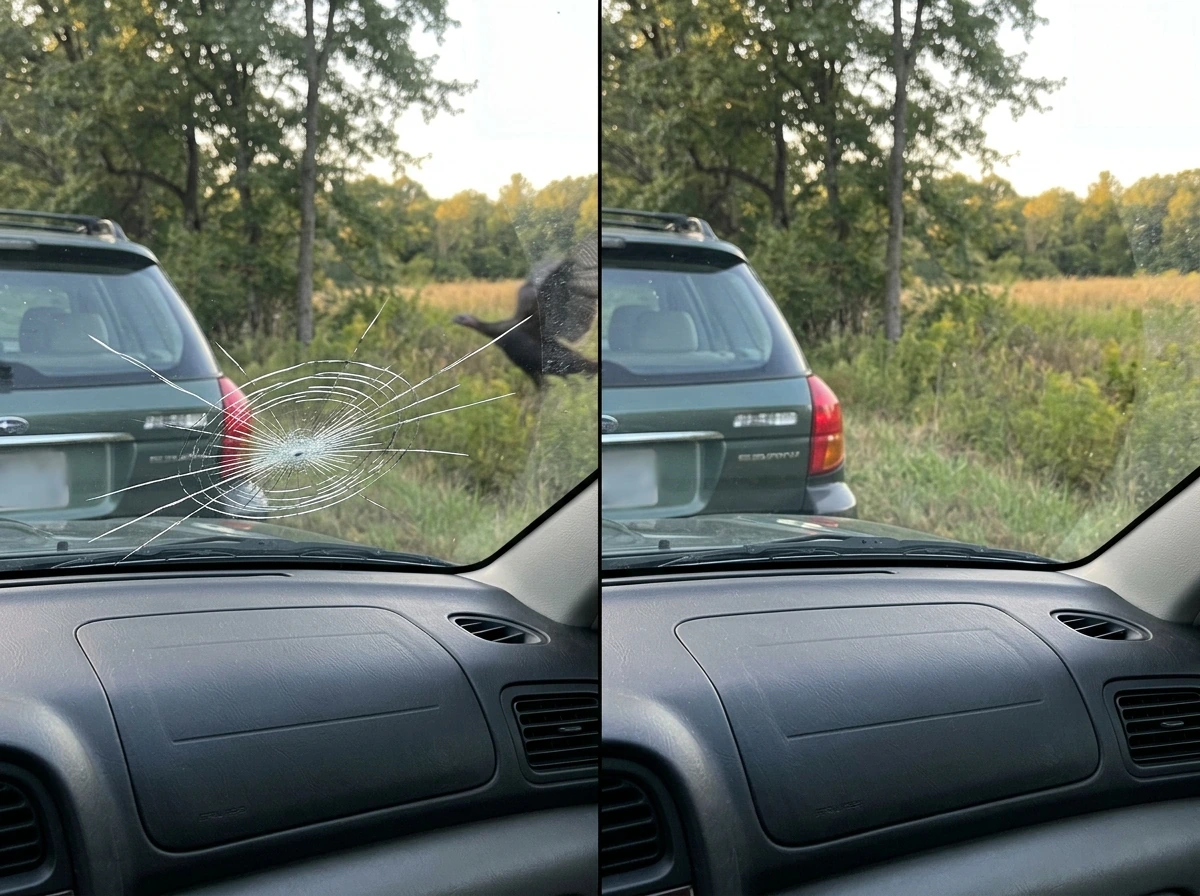
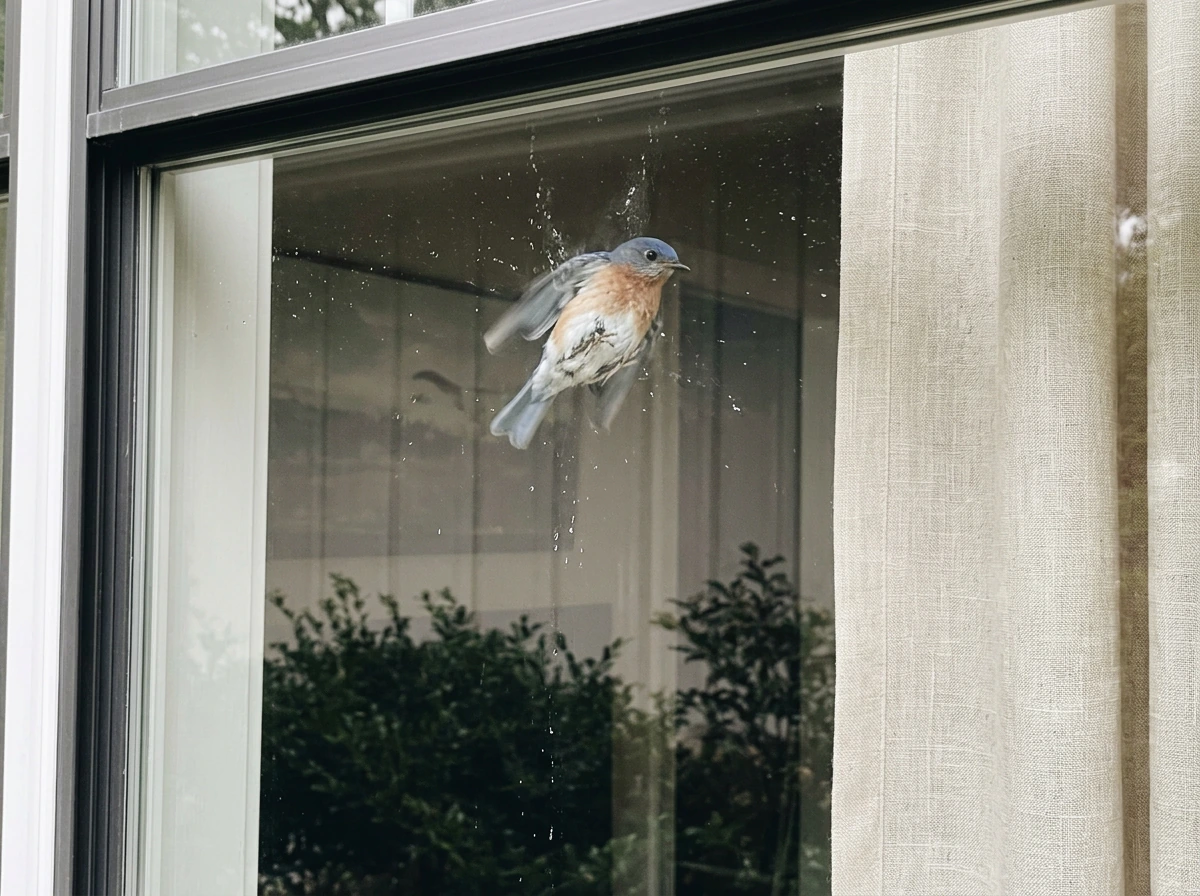
The short version: a large bird (think Canada goose, wild turkey, or great blue heron) hitting a windshield at highway speeds carries enough momentum to cause serious damage, including cracking the glass or even pushing the laminate inward. A small songbird hitting the same windshield at the same speed? Almost certainly not going to crack it. If your car has glass damage after a bird encounter and you were parked or driving slowly, there is a very good chance something else caused that crack.
What actually determines whether a bird damages your glass
Three things drive the damage equation: the size and mass of the bird, the speed of the vehicle, and the type of glass involved. All three matter, and none of them works in isolation.
Bird size and mass
Impact force scales with mass. A 12-pound Canada goose hitting your windshield delivers dramatically more force than a 1-ounce house sparrow. There are documented real-world cases of large birds, including geese and herons, smashing through car windshields entirely, with feathers embedded in the glass afterward. Smaller birds, even at the same speed, simply do not have the mass to generate that level of force on a standard automotive windshield.
Vehicle speed
This is the most important variable. Impact force does not scale linearly with speed. It increases with the square of the speed difference between the car and the bird. That means doubling your speed quadruples the impact force. Aviation research confirms this principle: a low-speed bird impact on a windshield typically causes no structural damage, while the same bird at a higher speed can cause considerable damage. On the highway at 65 to 75 mph, even a medium-sized bird carries meaningful kinetic energy. In a parking lot at 5 mph, almost nothing is going to crack your glass.
Type of glass
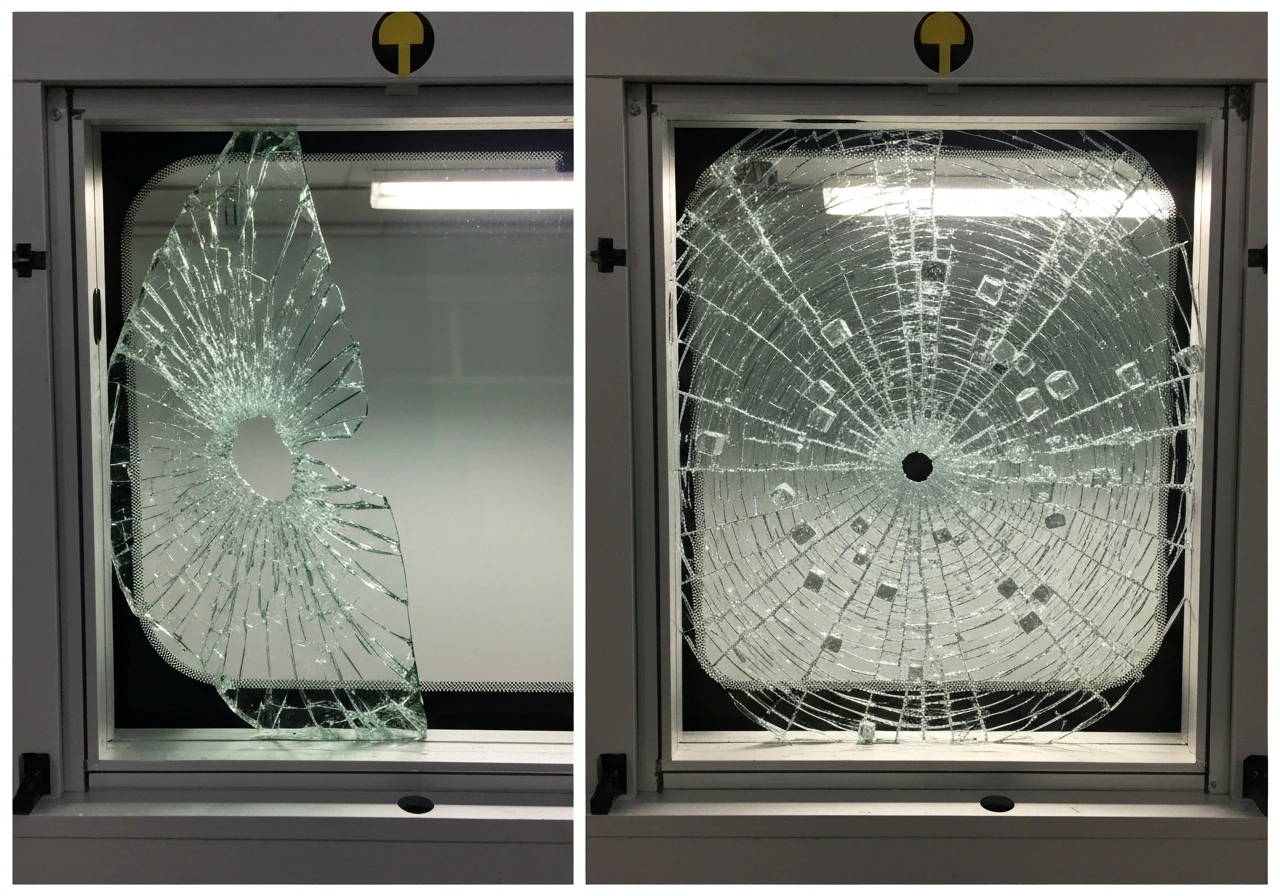
Car windshields in the U.S. are laminated safety glass, required under federal motor vehicle safety standards (FMVSS No. Federal Motor Vehicle Safety Standard (FMVSS) No. 205 is codified at 49 CFR § 571.205 and specifies glazing-material requirements, including for glass-plastic laminated glazing used in vehicles. 205). Laminated glass has a plastic interlayer sandwiched between two glass layers, which is why windshields crack in a spider-web pattern rather than shattering into sharp pieces. The thickness of that plastic interlayer directly influences how much impact the glass can absorb before it gives way. Side and rear windows are typically tempered glass, which is harder to crack from impact but shatters into small cubes when it does fail. A bird hitting a side window is actually less likely to crack it than a windshield, because tempered glass is engineered to resist sharp point impacts, but if it does fail, it will fail completely.
Angle of impact
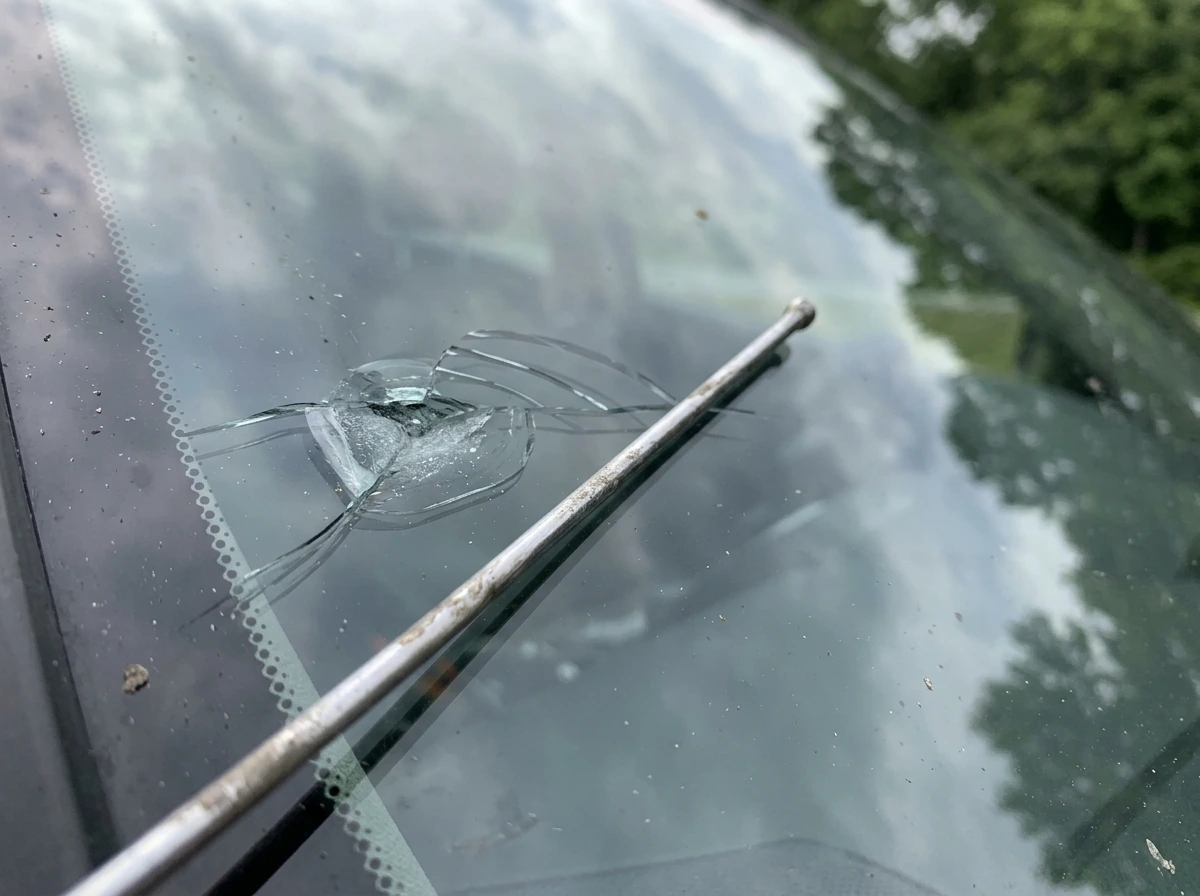
A glancing blow transfers less energy than a direct perpendicular hit. Most bird strikes on moving vehicles are somewhat oblique because the bird is trying to change direction at the last moment. A direct head-on impact from a large bird at highway speed is the worst-case scenario. Angle matters enough that the same bird at the same speed can be a near-miss in one situation and a windshield cracker in another.
Myths vs. reality: other things that crack windshields
Here is where a lot of people get confused. If you find a crack in your windshield and you remember a bird hitting it recently, it is easy to connect those two events. But in most cases, especially if the bird was small or the car was not moving fast, the crack probably came from something else.
The most common real culprits include road debris (gravel and small rocks kicked up by other vehicles), hail, temperature stress (sudden temperature changes between a cold night and hot sun, or blasting a defroster on a frozen windshield), and pre-existing stress fractures that finally propagate. Vandalism and manufacturing defects are less common but do happen. Auto glass industry data consistently identifies road debris as the leading cause of windshield chips and cracks, and chips left unrepaired can spread into full cracks from nothing more than a bump in the road.
| Cause | Typical damage pattern | Likely scenario |
|---|
| Small bird strike (parked/slow speed) | Smear, feathers, no structural damage | Bird confused by reflection |
| Large bird strike (highway speed) | Spider-web crack, possible laminate deformation | Highway driving in bird-heavy areas |
| Road gravel/debris | Small chip that spreads into a crack | Following trucks or driving on loose-surface roads |
| Hail | Multiple small impact points, pitting | Storm exposure |
| Temperature stress | Crack from edge, no impact point | Rapid temperature change |
| Vandalism | Clean break or sharp impact point | Parking in exposed or high-risk areas |
If your windshield has a crack starting at the edge of the glass with no obvious impact point, that is almost certainly a temperature or stress fracture, not a bird. If the crack radiates from a small chip in the center of the glass, that is road debris. A bird strike from a large bird at speed tends to leave a more dramatic, central impact zone, and you would likely have known something hit you.
What to do right now after a bird hits your car
Whether or not the glass is damaged, there are two things you need to deal with immediately: the bird itself and your vehicle. Handle the bird first.
Checking on the bird
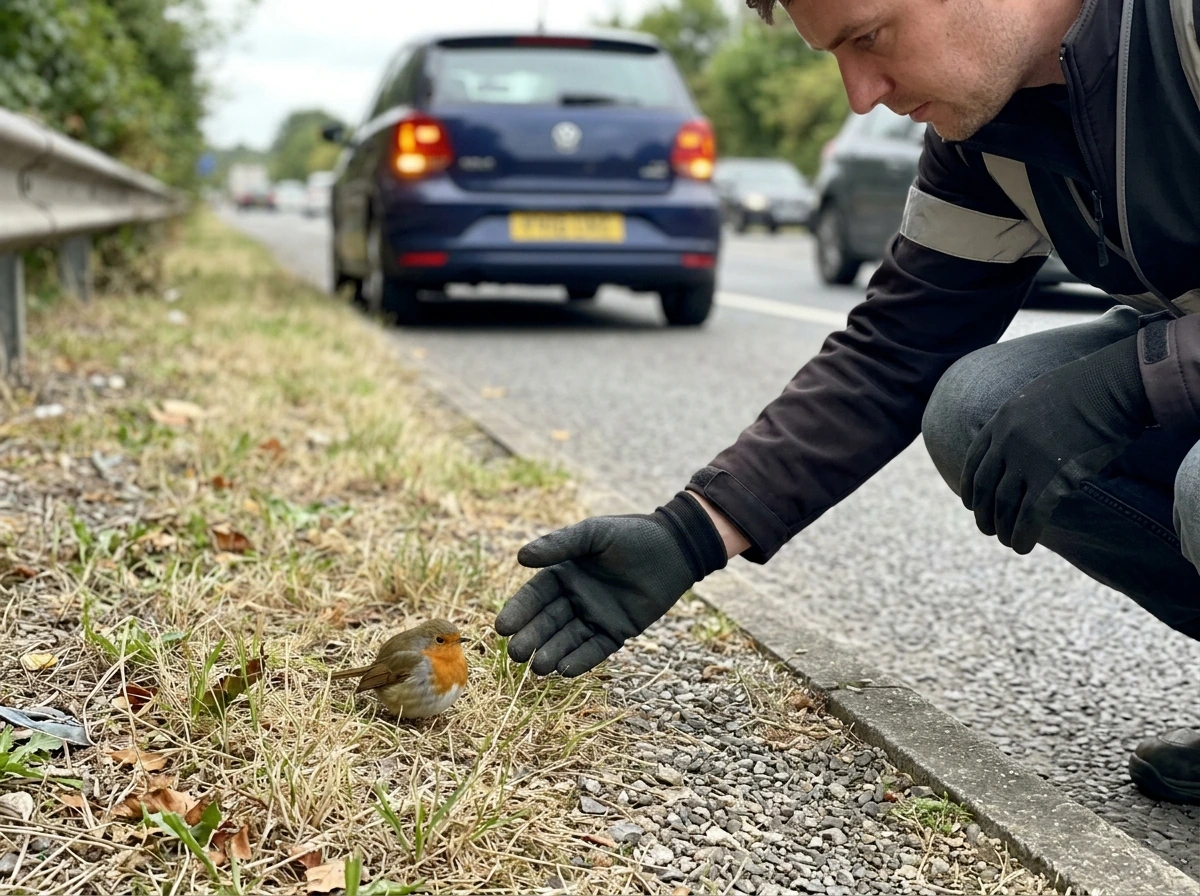
If the bird is on the ground and appears stunned, do not assume it is fine just because it is still alive. Birds often have internal injuries after a window or windshield collision, even if they are sitting upright and blinking. Audubon and wildlife rehabilitators consistently note that window-collision birds need professional evaluation, not just a few minutes to shake it off.
- If it is safe to stop, pull over and approach the bird calmly and slowly.
- Do not pick it up with bare hands if you can avoid it. Use gloves or a cloth if you have them.
- Place the bird gently in a cardboard box or paper bag with air holes. Keep it dark, quiet, and away from pets and traffic.
- Do not offer food or water. Injured birds can aspirate liquids.
- Contact a licensed wildlife rehabilitator as soon as possible. Your state wildlife agency or a quick web search for 'wildlife rehabilitator near me' will find local options.
- If the bird is clearly dead, handle it with gloves and avoid direct contact with blood or tissue.
If you were on a highway and cannot safely stop, that is genuinely a situation where stopping is more dangerous than continuing. Note the location and, if the bird appeared injured, you can report it to local wildlife authorities when you reach a safe stopping point.
Checking your vehicle
Once the bird is handled, look at your glass carefully. If there is a chip or crack, even a small one, get it looked at promptly. Chips in windshields can spread into full cracks from heat, vibration, or another impact. Safelite and other auto glass repair services can fill a chip before it becomes a replacement job. Safelite has described windshield chip repair adoption and repair outcomes in its press materials, including statistics on repairs performed Safelite and other auto glass repair services can fill a chip before it becomes a replacement job.. If the crack is already significant, driving with compromised windshield integrity is a structural safety issue, not just a cosmetic one, because the windshield is part of your vehicle's roof-crush protection.
Health risks and cleanup after a bird strike
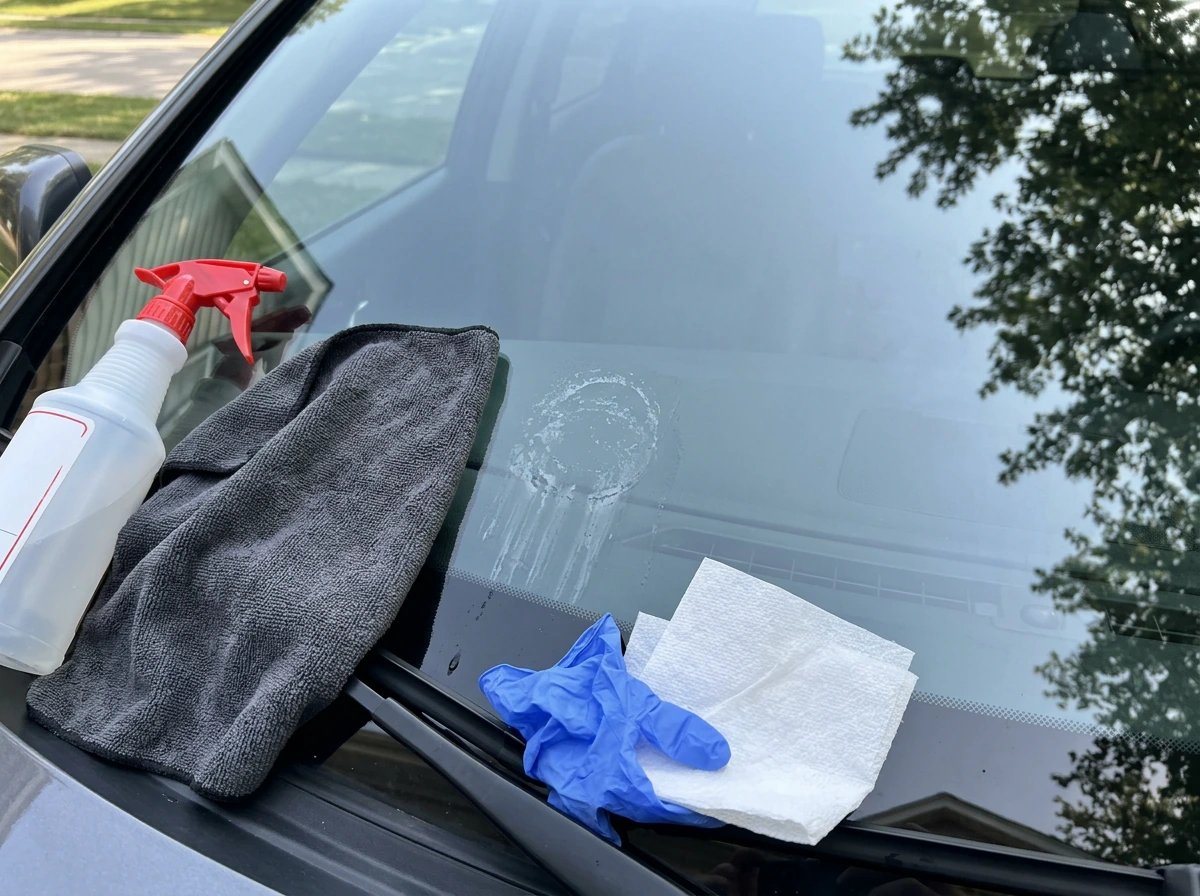
A bird that hits your car can leave behind blood, feathers, tissue, or droppings. This is not just a mess. There are real but manageable health considerations to be aware of.
Bird droppings and body fluids can carry pathogens including West Nile virus and other diseases. The CDC notes that dead birds are actively monitored for West Nile virus and that cleanup of bird remains warrants basic protective measures. The risk from a single casual contact is generally low, but it is not zero, and the precautions are simple.
- Wear disposable gloves when cleaning up feathers, blood, or remains from your vehicle.
- Avoid touching your face while handling contaminated materials.
- Use a diluted bleach solution (OSHA recommends a 1: 10 bleach-to-water ratio for surface decontamination) or a standard disinfectant spray to clean the affected area of your car.
- Bag the gloves and any contaminated cleaning materials and dispose of them in a sealed trash bag.
- Wash your hands thoroughly with soap and water after cleanup.
- Bird droppings on paint can etch the finish if left too long. Rinse with water and clean the area as soon as practical to avoid paint damage.
If you have open cuts or wounds on your hands, or if you are immunocompromised, wear double gloves and consider consulting a doctor if you had direct contact with blood or tissue. For most healthy adults doing a quick cleanup with gloves, the risk is minimal with basic precautions.
How to prevent birds from hitting your car again
Bird-car collisions happen for a few reasons. On the road, birds misjudge the speed or approach of a moving vehicle. When a car is parked, birds often mistake a window's reflection of the sky or nearby vegetation for open space and fly straight into it. If you have a particular spot where birds keep hitting your parked car, you can actually do something about it.
For parked vehicles near problem areas
The same principles used to reduce building window collisions apply here, though car windows present a more temporary challenge. If your car is regularly parked in a spot where birds are hitting it, the goal is to break up the reflection so birds do not perceive the glass as open space. Temporary window clings, strips of tape on the exterior glass, or UV-reflective decals (placed close together, not just one or two) can disrupt the reflection enough to deter birds. Research on bird-window collisions, including guidance from the USFWS and Audubon, emphasizes that coverage and spacing matter: markers need to be placed densely (roughly every 2 to 4 inches) to be effective. A single decal in the center does not do much.
Repositioning your car is the easiest fix if the problem is tied to a specific parking spot near a hedge, shrub, or reflective surface. Moving even 10 to 15 feet can eliminate the angle that is causing the reflection birds are responding to. (If you are interested in why birds behave this way around glass more broadly, that is covered in depth in the article on why does a bird fly into a window.)
For driving in bird-heavy areas
Reducing your speed through areas with high bird activity (wetlands, open farmland, areas near large bodies of water where waterfowl are active) directly reduces impact force if a strike does occur. This is especially true at dawn and dusk when birds are most active and light conditions make both you and them less aware of each other. Slowing down from 65 to 45 mph in a bird-dense area does not just reduce your chance of a strike. It dramatically reduces the force of any strike that does happen.
If the bird activity is tied to a specific location you drive through regularly, such as a road through a marsh or near a wildlife area, being more alert and covering the brake in that stretch is a simple habit that makes a real difference. Large birds like herons and geese tend to fly low and cross roads unpredictably, so those are the species to watch for when it comes to actual glass damage risk.
When to involve property maintenance
If you park in a lot or garage that has a documented bird collision problem, and especially if there are multiple cars being hit in the same area, it is worth raising the issue with building or property management. Large reflective glass panels near parking areas are a common culprit. The USFWS has published guidance on retrofitting building glass with markers or films to reduce collisions, and property managers can implement these solutions on a building scale far more effectively than individual car owners can.