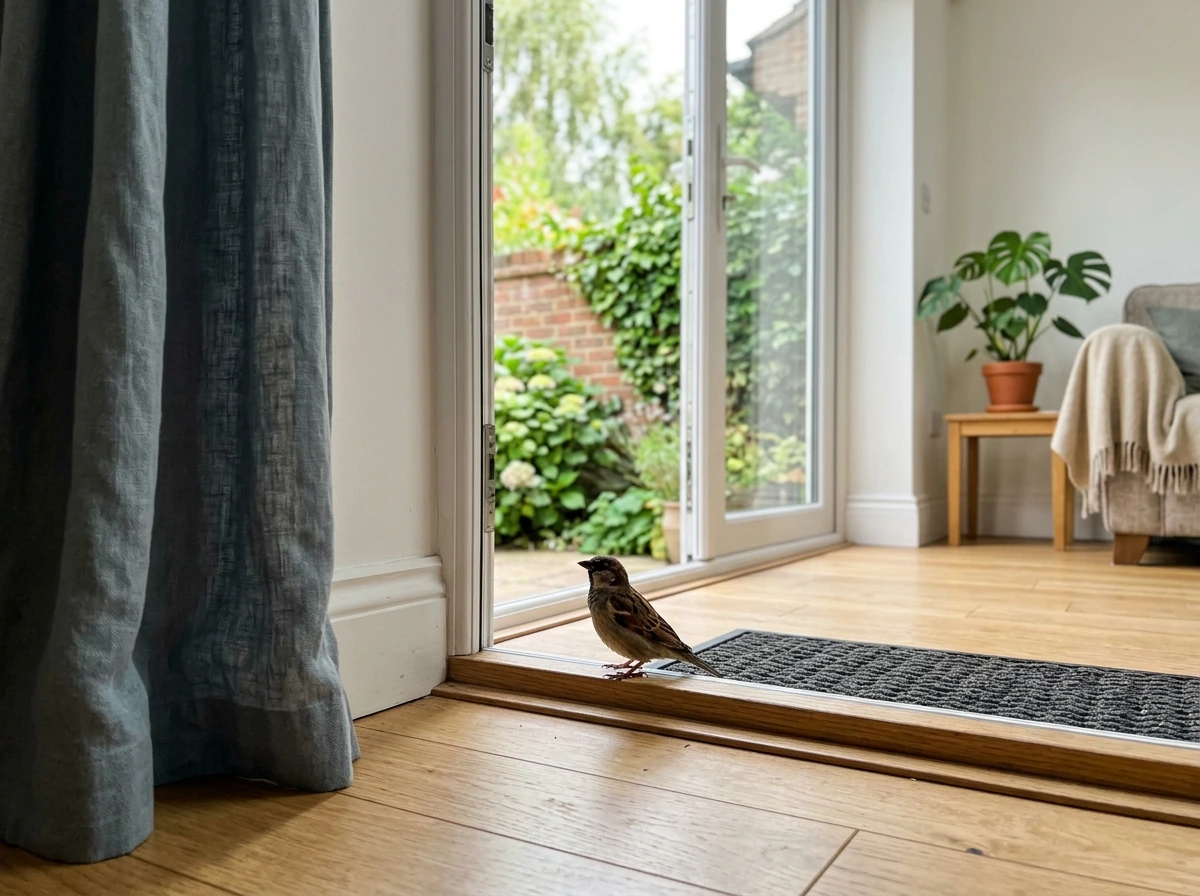
Birds fly into windows because glass is effectively invisible to them. They don't see a barrier, they see sky, trees, or open space reflected on the surface, and they fly toward it. That's the short answer. The longer answer matters too, because if a bird keeps hitting your window repeatedly, there's almost always a specific, fixable reason. can a bird break a car window This guide will help you figure out exactly what's happening at your window and give you real steps to stop it today.
Why Does a Bird Fly Into a Window and How to Stop It

Maya Chen
23 Mar 2026
Why birds hit windows in the first place
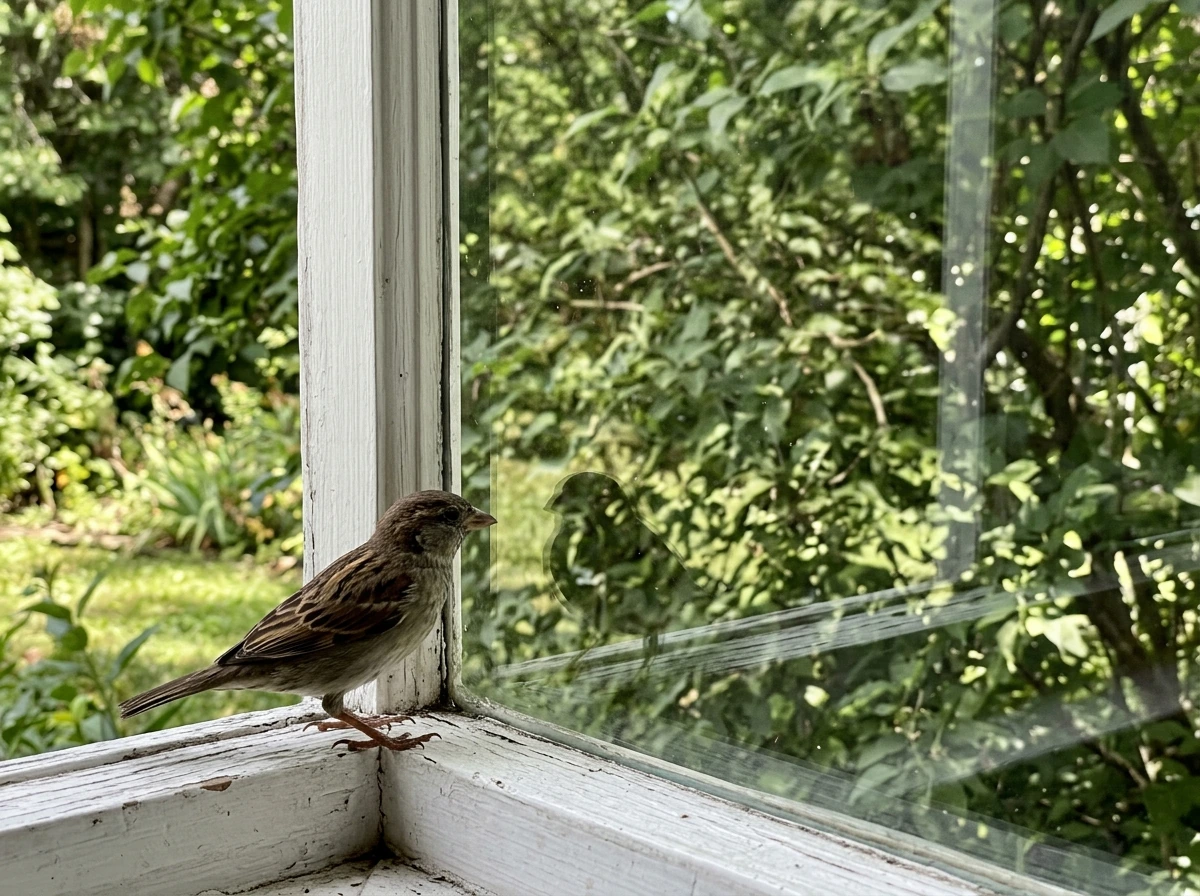
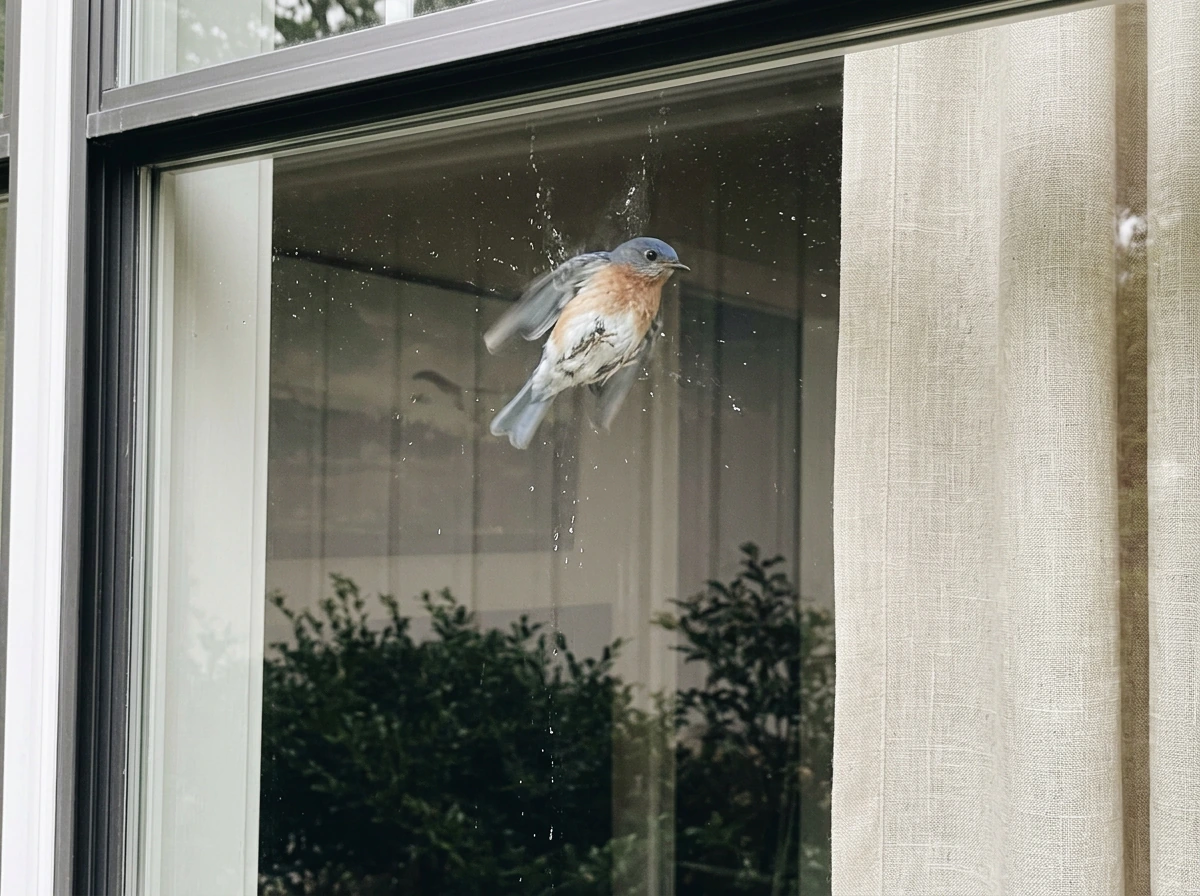
Glass is a uniquely human invention, and birds have no evolutionary experience with it. Research going back to Daniel Klem's foundational 1989 work in the Wilson Bulletin confirms that birds simply don't perceive glass as a barrier. What they do perceive is whatever the glass reflects or transmits, and that's where the danger lies.
There are two main collision pathways. The first is the "flythrough" collision: a window reflects nearby trees, shrubs, or open sky so convincingly that a bird sees it as habitat or open air and flies straight at it. The second involves artificial light at night, where interior or exterior lights visible through windows disorient birds, particularly migratory species, drawing them in until they collide. Both mechanisms can cause repeat strikes at the same window, and both are solvable once you know which one you're dealing with.
Lighting conditions make a real difference. A 2022 study in Avian Conservation and Ecology found that collision risk shifts with time of day and how interior and exterior light hits the glass surface. A window that's a mirror in morning light might be perfectly safe by noon. That explains why you might notice strikes at the same window, at the same time each day, almost like clockwork.
Why it keeps happening again and again
If a bird keeps flying into your window repeatedly, there's usually one of three things going on: territorial behavior, nesting instincts, or a well-worn flight path that keeps routing the bird past a dangerous window.
During spring and early summer, male birds will attack their own reflection in a window because they perceive it as a rival. Robins, cardinals, and mockingbirds are classic repeat offenders. The bird isn't confused about glass being a barrier in this case, it's actually deliberately charging at what it believes is another bird. This territorial behavior can go on for weeks until nesting season winds down.
A completely different cause is routine flight paths. Birds that regularly visit a feeder, a bath, or specific trees near your home can develop habitual routes that pass a dangerous window. Because birds don't learn to avoid glass through trial and error (a stunned bird that recovers and flies off doesn't walk away with a lesson learned), the same window keeps catching the same birds. A 2023 study in the Wilson Journal of Ornithology confirmed that many birds stunned by window strikes die later, making recurrence seem mysterious when the cause (the visual cue at that window) is never addressed.
Migration season adds another layer. During spring and fall, unfamiliar birds pass through your area and encounter windows they've never seen before. Night-migrating birds are especially vulnerable when interior lights are visible through windows, drawing them off course and into collisions. The AP News has reported on how collision rates rise sharply during peak migration periods, tied directly to light pollution and indoor lighting visible through glass.
How to figure out what's attracting the bird to your window
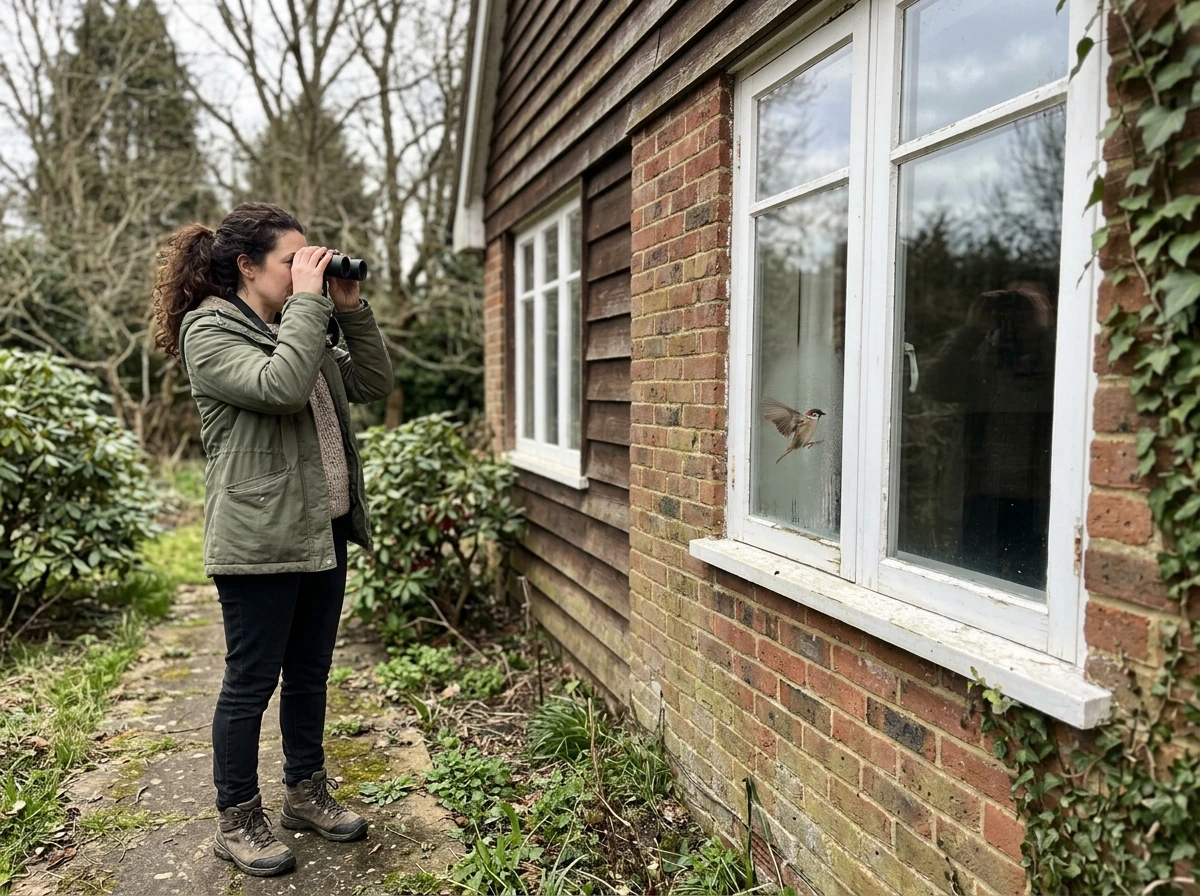
Before you start fixing the problem, spend a few minutes observing. The clues you need are usually obvious once you know what to look for.
Look at what the window reflects from outside
Go outside and stand where a bird would be approaching from. Does the window reflect a tree, a shrub, your garden, or open sky? If yes, you're almost certainly dealing with a flythrough collision, birds are trying to reach the habitat they see in the reflection. The U.S. Fish and Wildlife Service's Bird-Friendly Home Toolkit specifically flags windows that reflect trees, plants, or sky as the highest-priority hazard to address.
Check what the bird is actually doing
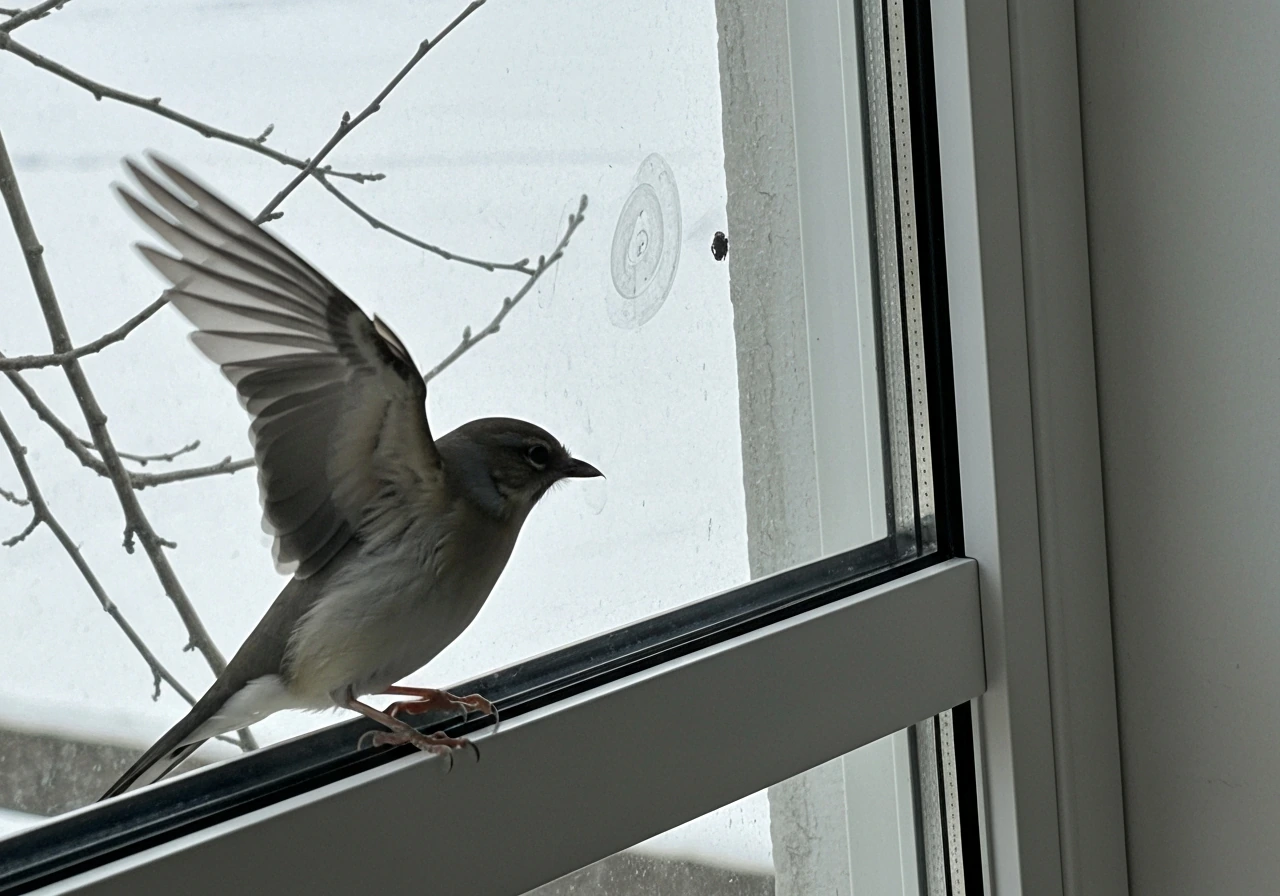
Is the bird hovering in front of the window, tapping repeatedly at one spot, or charging at the glass from a perch? That's territorial behavior. Is it hitting the window at speed and appearing stunned or injured? That's a flythrough strike. Does it happen at night or when interior lights are on? That's the artificial-light pathway. Matching the behavior to the cause tells you exactly which solution to apply.
Note the time of day
Morning strikes at east-facing windows and afternoon strikes at west-facing ones are classic reflection-driven collisions, because those windows catch the sun at low angles and mirror the surrounding landscape most intensely. If strikes happen at night or very early morning, look at your interior and exterior lighting as the likely culprit.
Check your feeders and plants
A bird feeder or bird bath at an intermediate distance from a window (farther than 3 feet but closer than 30 feet) creates a high-risk flight path. Indoor plants visible through clear glass can also attract birds toward the window. These are simple, easy-to-spot causes that you can fix quickly.
What to do right now to stop the collisions
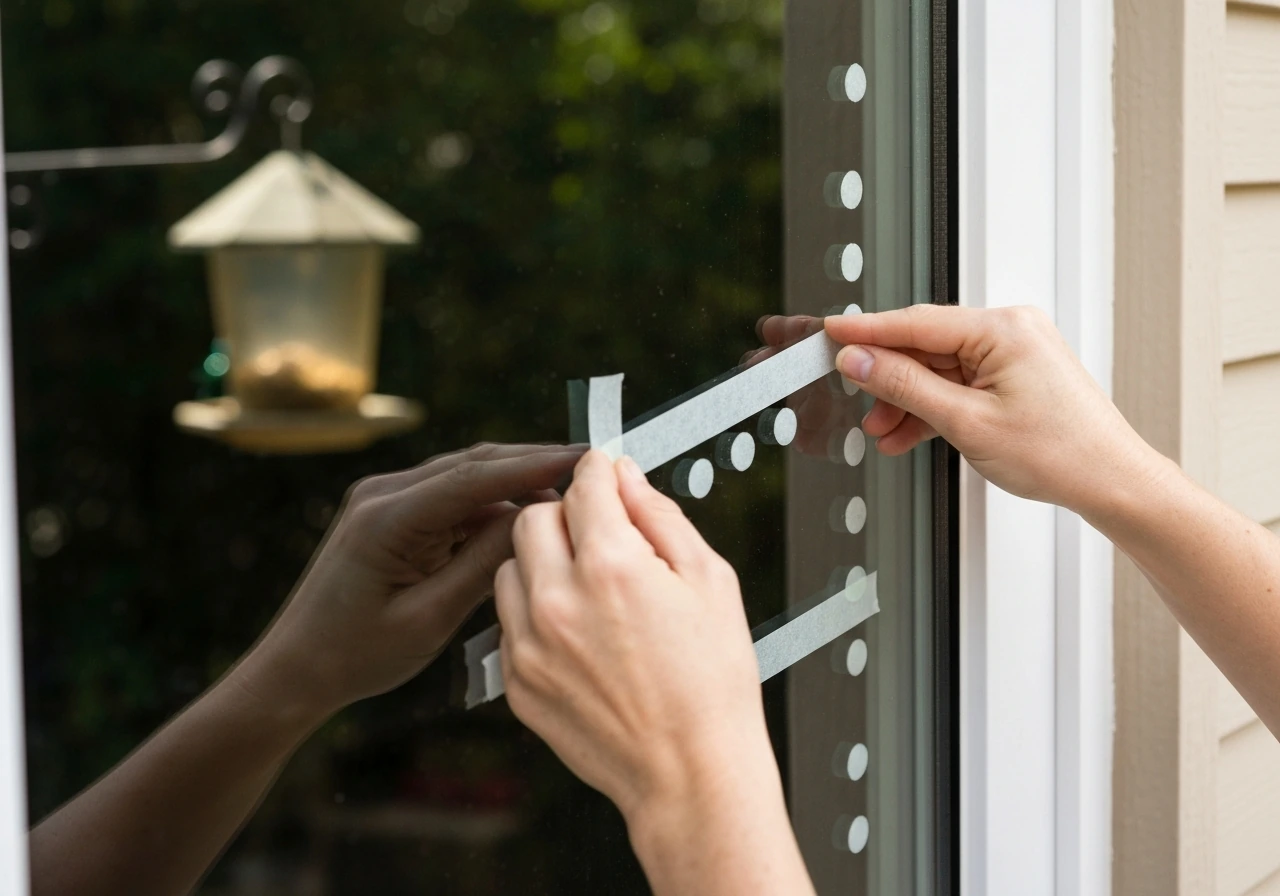
You don't have to wait for a permanent solution to reduce the risk today. Here are the fastest, most effective immediate steps.
- Apply window markers immediately. Decals, tape strips, or even soap marks on the outside of the glass work by making the surface visible to approaching birds. The key rule: markers must be spaced no more than 2 to 4 inches apart across the whole window. The U.S. Fish and Wildlife Service specifies a 2-inch by 2-inch spacing pattern. A single hawk silhouette in the middle does almost nothing — birds simply fly around the gaps.
- For territorial birds, block the reflection. Cover the outside of the window with window screen, close the blinds, or tape paper on the interior side. You need to eliminate the reflection so the bird stops seeing a rival. This is a temporary fix, but it works quickly.
- Move feeders and baths. Audubon recommends placing feeders either within 3 feet of a window or more than 30 feet away. At 3 feet or closer, a bird that flushes from the feeder can't build enough speed to injure itself. Beyond 30 feet, its flight path doesn't route it toward the glass.
- Move indoor plants. The Bird Collision Prevention Alliance recommends keeping plants visible through clear glass at least 3 feet back from the window, so they don't attract birds toward the surface.
- Turn off or dim interior lights when not in use, especially at night. Close blinds or curtains after dark during migration season (spring and fall especially). This directly reduces the artificial-light collision pathway.
- If exterior lights are near a problem window, shield or angle them downward, or switch them off during migration periods.
Longer-term fixes that actually prevent window strikes
Immediate steps buy you time. These longer-term measures address the root cause so you're not constantly re-applying tape and hoping for the best.
Window film and patterned glass
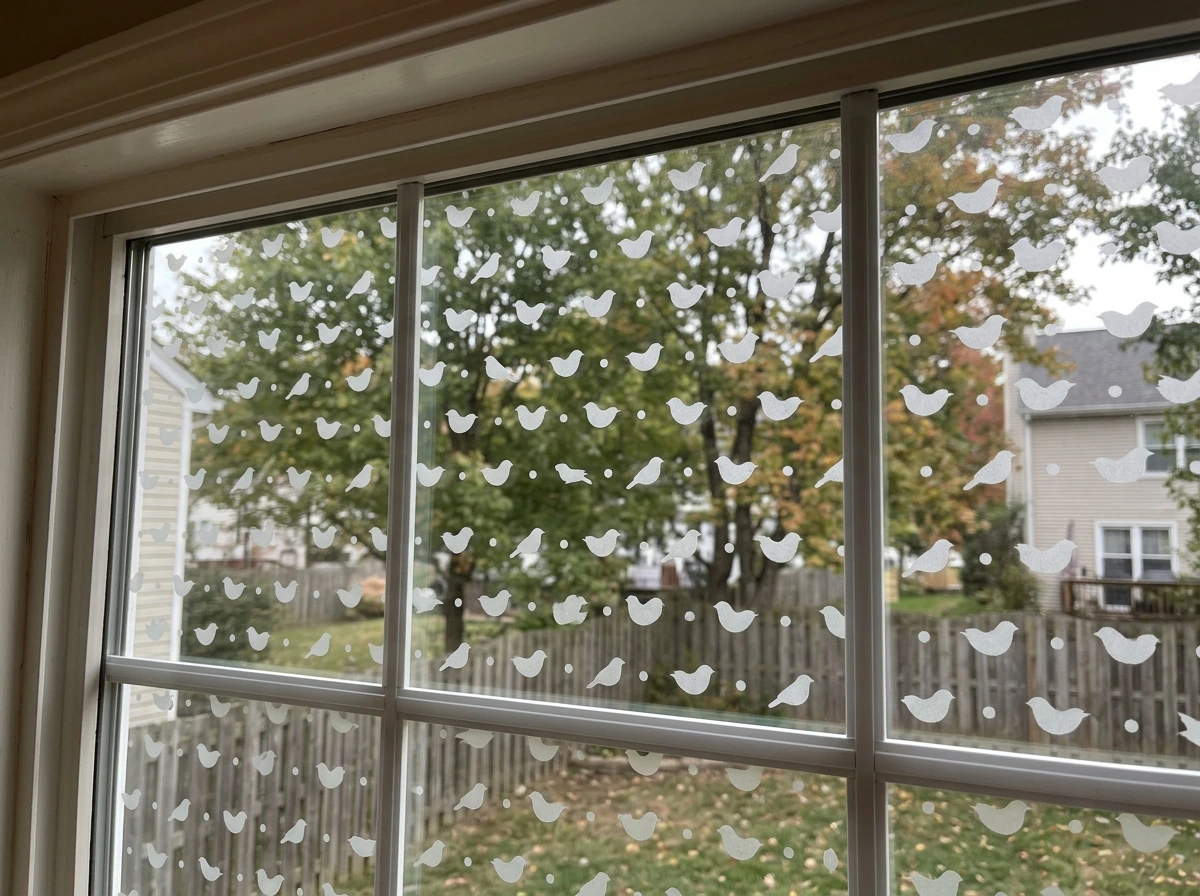
Professionally applied bird-deterrent window film is one of the most effective long-term solutions. Films like UV-reflective products (which birds can see but humans largely can't) and frosted or etched films make the glass surface detectable to birds without dramatically changing how your window looks from inside. Applied correctly at the right spacing, these films turn a dangerous window into a safe one permanently.
Dense decal patterns (done right)
If you prefer decals over film, they work, but only when applied properly. Audubon is clear on this: space decals no more than 2 to 4 inches apart across the entire window. For a large window, that means a lot of decals. The look is more marked-up than film, but it's far better than a sparse pattern that birds fly through. Apply them on the outside surface when reflections are the main issue, so birds see them from the approach angle.
External screens and shutters
Window screens installed on the outside are excellent at reducing collisions. They break up reflections and act as a physical buffer. The U.S. Fish and Wildlife Service notes that screens reduce both the reflective quality of glass and the impact force if a bird does hit the surface. External shutters or shade screens achieve a similar effect.
Curtains and interior blinds
Closing blinds and curtains, particularly at night during migration season, is a simple but meaningful long-term habit. For transparency-driven collisions (birds can see through your window to habitat or plants inside), keeping interior blinds partially closed during daylight hours also helps reduce the see-through effect.
Landscaping and lighting adjustments
Over time, consider moving large shrubs or trees that are reflected prominently in problem windows, or place them in positions where they won't appear in the glass from a bird's approach angle. For exterior lighting, shielded and downward-angled fixtures reduce the light-pollution effect that draws migrating birds toward lit windows at night.
If the bird is injured or dead after hitting your window
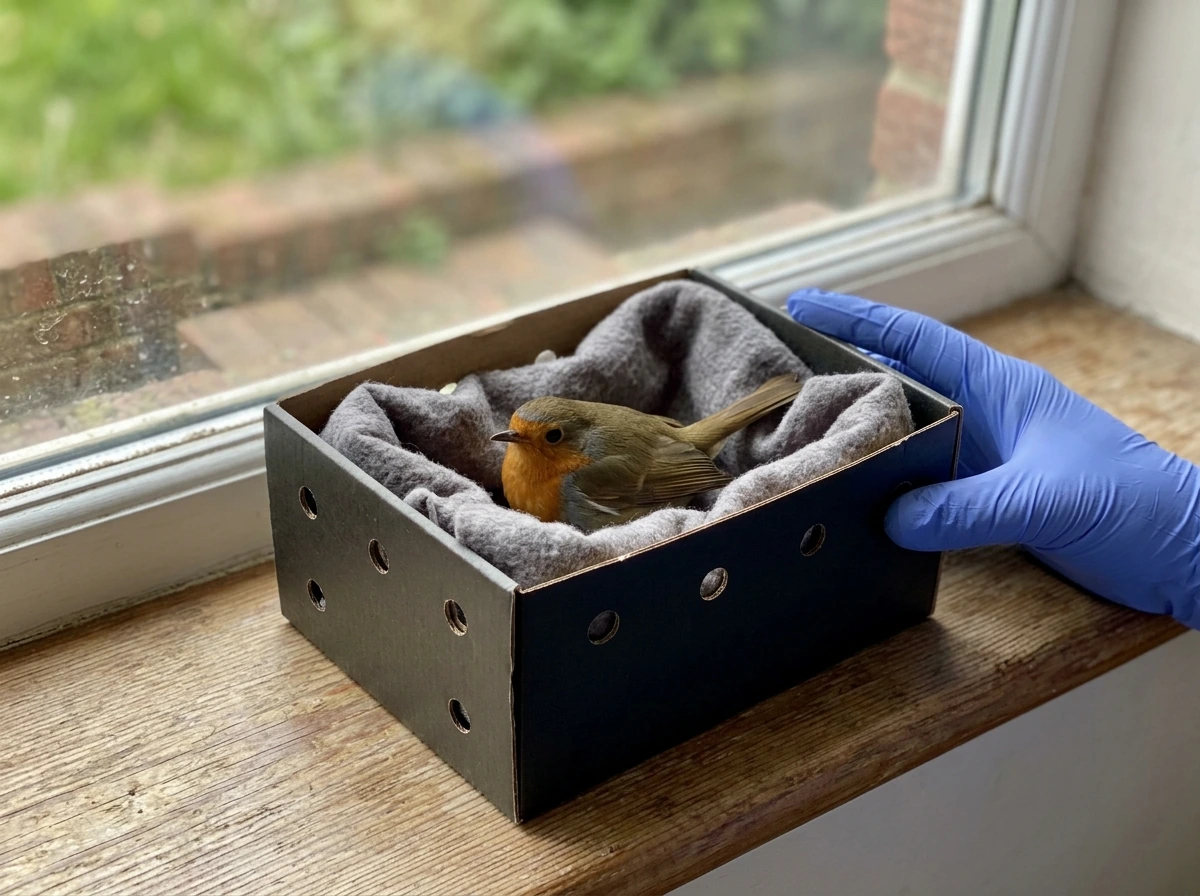
Window strikes are often more serious than they look, so what happens if bird enter into house can be serious if the bird is injured. A bird that appears merely stunned may have internal injuries and can die hours later. A 2023 study in the Wilson Journal of Ornithology found that many stunned birds that seem to recover do not survive. Take the situation seriously even when the bird looks alert.
For a stunned bird
- Don't handle the bird more than necessary. Use a clean, soft cloth or gloves to gently pick it up.
- Place it in a small, dark, ventilated box (a shoebox with air holes works well).
- Keep it warm and quiet, away from pets, children, and loud noise.
- Do not offer food or water — wildlife rehabbers advise against this because it can cause additional harm to an injured bird.
- Check on it after 30 to 60 minutes. If it seems alert and able to hold its head upright, you can take it outside, open the box, and let it fly away on its own.
- If it's still dazed, not moving well, or has visible injuries, contact a licensed wildlife rehabilitator. Audubon recommends getting the bird to a rehabilitator as quickly as possible for proper assessment.
For a dead bird
Handle a dead bird with gloves or a plastic bag turned inside out. Standard precautions apply: wash your hands thoroughly afterward. The health risk from a single dead bird found at your window is very low for a healthy adult, but basic hygiene is always a good idea. Dispose of it in a sealed bag in your regular trash.
If you find dead birds at your window repeatedly, consider reporting them to a local bird monitoring program. Data from home-based window strikes is genuinely useful to researchers, and several programs accept public reports.
Common myths that don't actually work
There's a lot of folk wisdom floating around about window strikes, and some of it does more harm than good by giving homeowners a false sense that the problem is solved.
| Myth | Reality |
|---|---|
| A single hawk silhouette decal will deter birds. | Birds fly around the gaps unless the entire window surface is marked at 2 to 4 inch spacing. One silhouette leaves large open areas that birds pass through easily. |
| Birds will eventually learn to avoid the window. | They don't. Birds have no mechanism to reliably recognize glass as a barrier. Canada's Environment and Climate Change Canada explicitly states birds won't learn this safely via trial and error. |
| A plastic owl or fake predator near the window stops strikes. | These have no meaningful effect on window collision rates. The threat must be the glass surface itself being made visible, not a nearby decoy. |
| If the bird recovers and flies away, it's fine. | Many birds that appear to recover after a strike die hours later from internal injuries or neurological trauma. |
| Window strikes only happen in spring. | They happen year-round. Spring and fall migration peaks increase frequency, but territorial behavior in breeding season and resident birds cause strikes in every season. |
| Interior window films or tinted glass on the inside stop collisions. | Reflections come from the outside surface. Films applied only on the inside don't significantly reduce the reflective quality birds see from their approach angle. |
The most effective approach is always to make the glass itself visible and detectable to birds from the outside, at the correct spacing, across the full window surface. Anything that doesn't do that is at best a partial fix and at worst a false solution that leaves the problem unaddressed.
One more thing worth mentioning: if you've arrived at this article because someone told you a bird flying into a window carries a special meaning, there are separate perspectives on bird-related folklore worth exploring. But from a bird-safety standpoint, the meaning of the event is clear: your window has a visual hazard that needs to be fixed, and the bird needs help if it's still there when you go outside.
FAQ
Why do birds hit the same window again even after I clean the glass or reposition the feeder?
Cleaning and moving the feeder may not change what the window shows birds from their approach angle. The collision cue is usually reflections, see-through interior light, or a habitual flight path. Recheck the window at the same time of day the strikes happen, then confirm whether the bird is charging (territory), flying straight in (reflection/see-through), or hitting at night with lights on (light pollution).
Is the bird actually trying to fly through glass, or is it more like a misdirected approach?
Most strikes are misdirected approach toward what the bird perceives on the other side of the glass, like sky, trees, or habitat reflected on the surface, or a visible scene through the window. That means prevention works best when you make the window surface detectable to birds, rather than relying on hoping they will learn after a single scare or near miss.
Do window stickers or decals always prevent collisions?
They only work when spacing and coverage are correct. If decals are too far apart or only cover part of the window, birds can still fly through the gaps. Apply them to the outside surface when reflections are the driver, and ensure the pattern spans the full risky area across the window, not just the center.
What should I do if the bird keeps hitting at dawn or only in the morning?
Morning strikes often indicate low-angle sunlight is intensifying reflections on the east-facing side or on nearby reflective surfaces. Test by watching from the birds’ approach side around sunrise, then prioritize reflection fixes first, like external screens or bird-deterrent film, and consider adding temporary internal dimming (blinds/curtains) until you apply the longer-term measure.
If I suspect territorial behavior, how can I reduce repeated attacks?
Territorial strikes typically look like repeated hovering or charging at one spot, and they can continue for weeks. The most direct fix is removing the bird’s ability to see its reflection, so focus on non-transparent outside treatments (external screens, reflective-breakers, or properly applied film) rather than simply changing feeders.
Does turning off all lights at night fix the problem immediately?
It can significantly reduce night-migration and light-disorientation collisions, especially if the bird hits when interior lights are on. However, if reflections are still strong during daylight, you may see continued strikes at certain times. For best results, use light reduction plus a visible-to-birds window solution, then monitor for a few days to confirm the pattern changes.
How long after I apply deterrents should I expect to still see occasional strikes?
A short adjustment period can happen, particularly if birds are already following a habitual route past the window. If the cause is reflection, you should notice fewer strikes as soon as the deterrent is in place. If strikes persist beyond a few days at the same times, re-evaluate coverage, spacing, and whether the hazard is coming from adjacent reflected objects or nearby windows.
What window treatments are least effective for preventing strikes?
Treatments that preserve invisibility of the glass surface to birds, or that only partially cover the reflective area, are often ineffective. If the treatment does not make the entire risky surface detectable from the outside approach angle, you can end up with a false sense of security where birds still fly through gaps.
Should I report window-strike deaths or injured birds, and where does that help?
Yes, reporting can help local researchers understand which species and which windows are involved, and it can guide broader mitigation strategies. If you keep finding the same window hazardous, include dates and times, whether it was day or night, and what was nearby (trees, feeders, interior lights) so others can replicate the conditions and prioritize fixes.
Next Article
What Happens If a Bird Enters Your House: What to Do Now
Step-by-step response to a bird inside your house: keep safe, assess injury, prevent repeat window hits, and clean safel