
In most cases, no, a bird nest will not kill your plant. The vast majority of nests sit harmlessly in shrubs, trees, and hanging baskets without causing any measurable damage to the plant itself. That said, specific conditions, like a heavy nest on a fragile branch, concentrated droppings over weeks, or a bird species that actively pecks or strips bark, can tip the situation from harmless coexistence into genuine plant stress. Knowing which scenario you're actually dealing with is what this guide is for.
Will a Bird Nest Kill a Plant? What to Know and Do

Maya Chen
14 May 2026
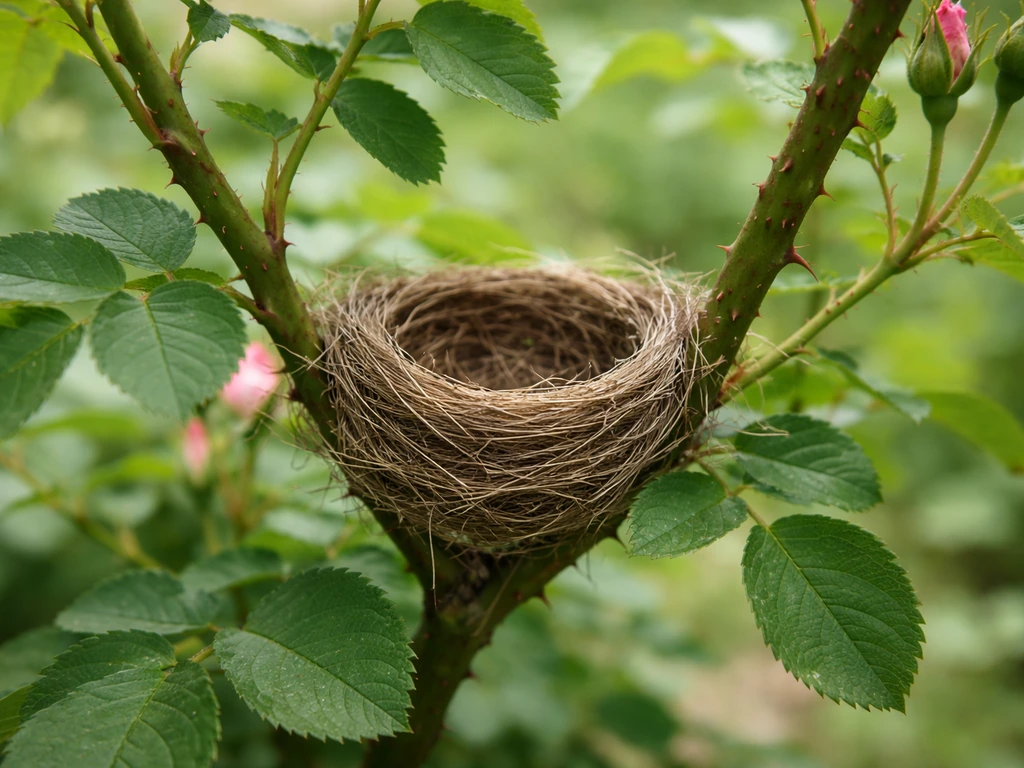
The short version: nests rarely kill plants, but a few situations can
A standard songbird nest in a rose bush or apple tree is not going to kill the plant. Birds have been nesting in vegetation for millions of years, and most plants handle it without issue. The problems that do arise tend to be mechanical, like branch breakage from weight, or indirect, like droppings accumulating at the base of a small container plant. Even then, the threshold for actual plant death is higher than most people expect. What you're more likely to see is minor stress, not sudden collapse.
One thing worth clearing up immediately: if you've spotted a fungal growth near your plant that looks like tiny bird nests with eggs inside, that's a completely unrelated organism called bird's nest fungus. University of Minnesota Extension confirms it grows only on decaying organic matter like mulch or manure, and it does not harm living plants at all. It's a decomposer, not a pathogen.
When a nest can actually hurt the plant
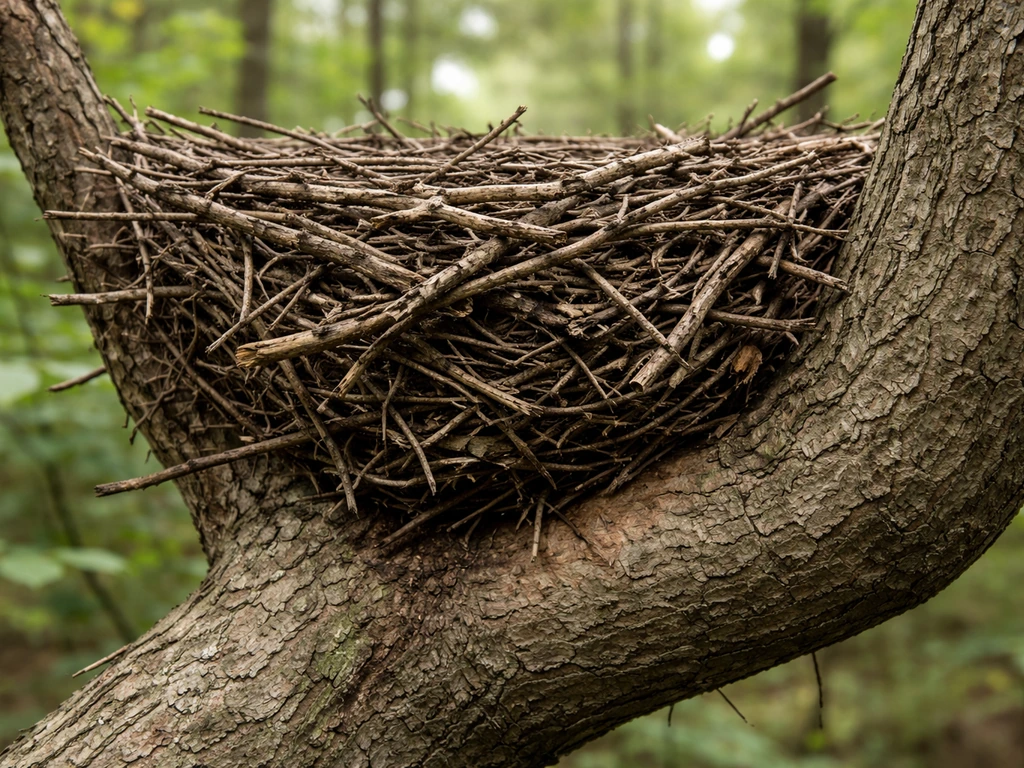
Physical and mechanical damage
The most direct way a nest damages a plant is through physical pressure. A large, dense nest built by corvids, herons, or raptors can weigh several pounds and create real leverage on a branch, especially after rain soaks the nest materials. If the branch is already narrow, young, or structurally weak, that weight can cause it to crack or snap. In smaller shrubs, even a modest nest at the growing tip can push stems sideways and cause them to bend or break under their own weight plus the nest.
Girdling is another risk to check for. If nest-building birds strip bark in tight rings around a stem to gather materials, or if nest fibers wrap tightly around a branch over time, they can cut off the vascular flow the plant needs to move water and nutrients. This typically affects young, thin-stemmed shrubs more than established trees.
Blocked light and airflow
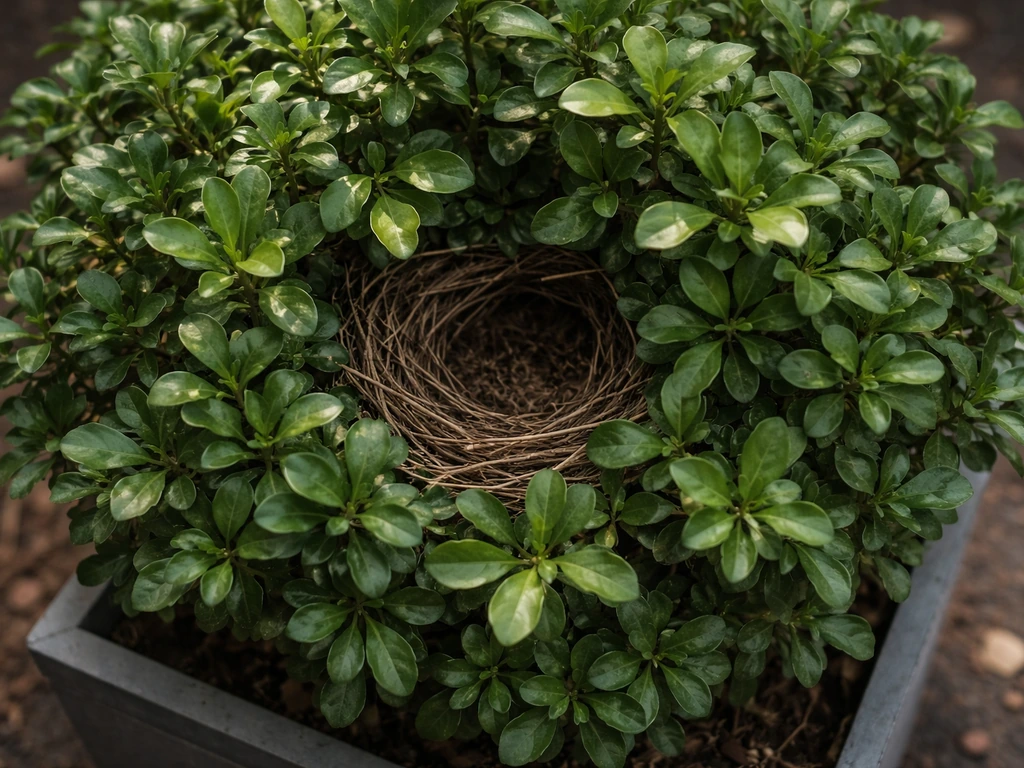
A bulky nest lodged deep in a dense shrub or small potted plant can block enough sunlight and air circulation to cause problems. This matters most for plants that already struggle with shade or humidity, or for small plants where the nest takes up a meaningful proportion of the canopy. A robin's nest in a large oak tree? Irrelevant to the tree's light budget. The same nest wedged into a dwarf boxwood in a container? More of an issue.
Sapsucker and woodpecker nesting damage
When the bird building the nest is also drilling into the bark, the calculus changes. Sapsuckers create rows of small holes in bark to access sap, and when they use the same tree as a nesting site, the combined bark damage can become significant. University of Maryland Extension notes that repeated sapsucker drilling can weaken trees and make them more vulnerable to disease and pests. This is one of the more direct paths from nesting activity to genuine plant injury.
The indirect risks that actually cause more problems
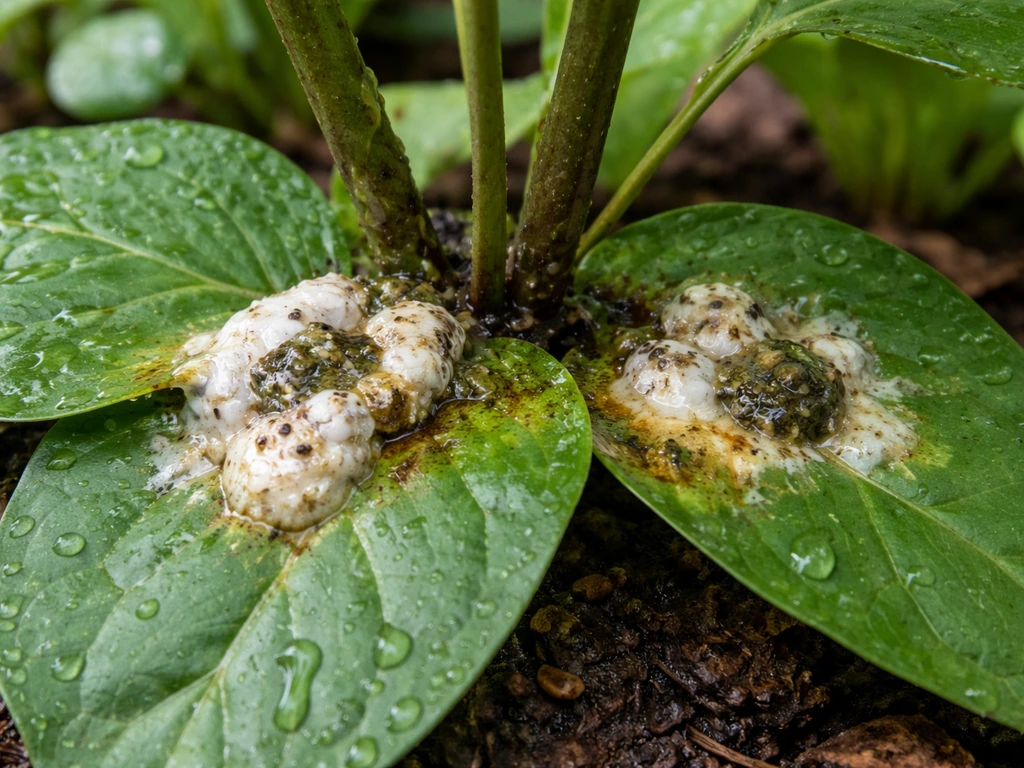
Droppings are the bigger story for most gardeners. Bird feces are high in nitrogen, and while that sounds like a fertilizer bonus, concentrated deposits in a small area can burn roots, acidify soil, and disrupt the nutrient balance around the plant's root zone. Research on colonial nesting birds shows that accumulated guano can meaningfully change soil chemistry and affect plant communities over time. D.J.R. Lafferty and colleagues report that guano deposition from colonial nesting cormorants can acidify soils and affect native vegetation and plant diversity in colony contexts over the longer term Research on colonial nesting birds shows that accumulated guano can meaningfully change soil chemistry and affect plant communities over time.. For a large tree with dozens of birds roosting season after season, this is a documented effect. For a single songbird nest, the amount is too small to cause harm.
Moisture and mold are worth watching too. Nest materials, especially old, wet nests, can trap moisture against bark or inside a container, creating conditions for fungal growth or rot. This is more of a concern after the nesting season ends and the nest is abandoned and left to decompose in place.
Droppings can also attract insects and other pests that may then go after the plant itself. USDA APHIS notes that heavy droppings from starlings and blackbirds can create conditions that support fungal organisms like Histoplasma in soil, though this is primarily a human health concern rather than a direct plant threat. Still, if you're managing a vegetable garden or beds where you work closely with soil, that's relevant context.
How species, nest size, plant type, and location change the risk
Not all nest situations are equal. A hummingbird nest the size of a golf ball poses essentially zero structural or chemical risk to any plant. A great blue heron colony nesting in the same stand of trees season after season is a documented cause of tree decline and soil change. The factors that matter most are nest size and weight, how many birds are involved, whether the nest is in a tree, shrub, or container, and how robust the plant is.
| Scenario | Risk to Plant | Main Concern |
|---|---|---|
| Small songbird nest in established tree | Very low | Essentially none |
| Small songbird nest in potted plant | Low to moderate | Moisture, minor root competition, droppings in confined soil |
| Large corvid or raptor nest on branch | Moderate | Branch breakage from weight |
| Colonial nesters (herons, cormorants) in trees | Moderate to high | Soil acidification, bark damage, accumulated guano |
| Woodpecker or sapsucker nesting in tree | Moderate | Bark injury, vascular damage, disease entry points |
| Nest on young or fragile shrub | Moderate | Stem breakage, girdling, light/airflow blockage |
Container plants deserve special mention. Because the root zone is confined, any extra nitrogen from droppings has nowhere to dilute into surrounding soil. A nest occupied by multiple adults and chicks over several weeks in a small hanging basket can overload that limited soil volume more easily than the same nest in a garden bed.
What to check on your plant right now
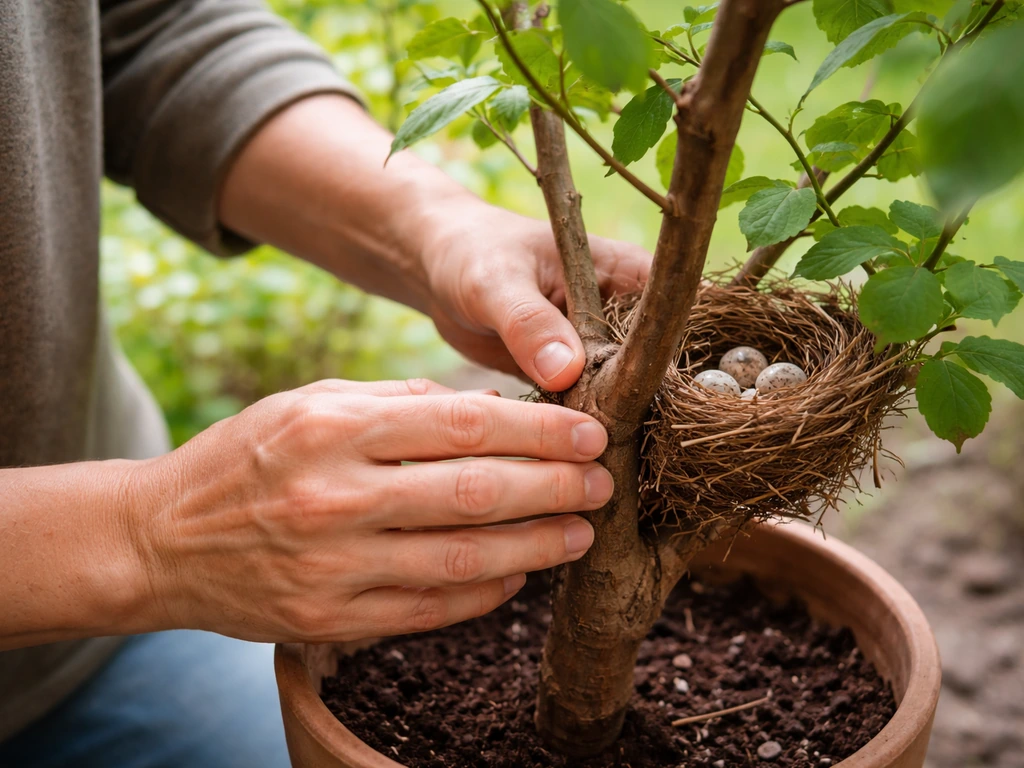
If you're looking at an active or recently vacated nest and wondering whether your plant is in trouble, here's what to actually look at.
- Branch angle and integrity: Is the branch holding the nest bent, cracked, or visibly sagging more than it was before? Press gently and check for give where there shouldn't be any.
- Girdling: Look at the base of the branch or stem where the nest sits. Are any fibers, vines from nest materials, or strips of bark wrapped tightly around the stem? Any constriction that digs into bark is a warning sign.
- Leaf condition in the nest zone: Are leaves directly around the nest yellowing, browning, or dropping faster than leaves on other parts of the plant? This can signal blocked light, damaged vascular flow, or chemical burn from droppings.
- Soil or potting mix condition: In container plants, check if the soil smells sour or looks waterlogged around the nest base. Check for unusual discoloration or crusty white deposits from concentrated droppings.
- Bark condition: For trees where a woodpecker or sapsucker is involved, look for rows of small holes, sap weeping from bark, or dark staining that suggests fungal entry.
- Overall plant vigor: Step back and compare the side of the plant near the nest to the rest. Wilting, stunted new growth, or premature leaf drop in that zone tells you something is affecting that part of the plant.
What you can safely do right now
If the nest is active (eggs or chicks present)
Leave it alone. Under the Migratory Bird Treaty Act, which protects roughly 1,100 native bird species, disturbing or destroying an active nest can constitute illegal "take." The nesting season for most North American species runs roughly from March through August, though exact timing varies. Your practical job during this period is observation, not intervention. Watch for structural problems, support any branches that look strained, and wait.
Supporting stressed branches
If a branch holding an active nest looks like it's under real mechanical stress, you can add support from below without disturbing the nest. A garden stake tied loosely under the branch with soft cloth or plant tape can offload some of the weight while the nest is occupied. Don't tie anything around the branch itself tightly, and don't touch or reposition the nest.
After the nest is vacated
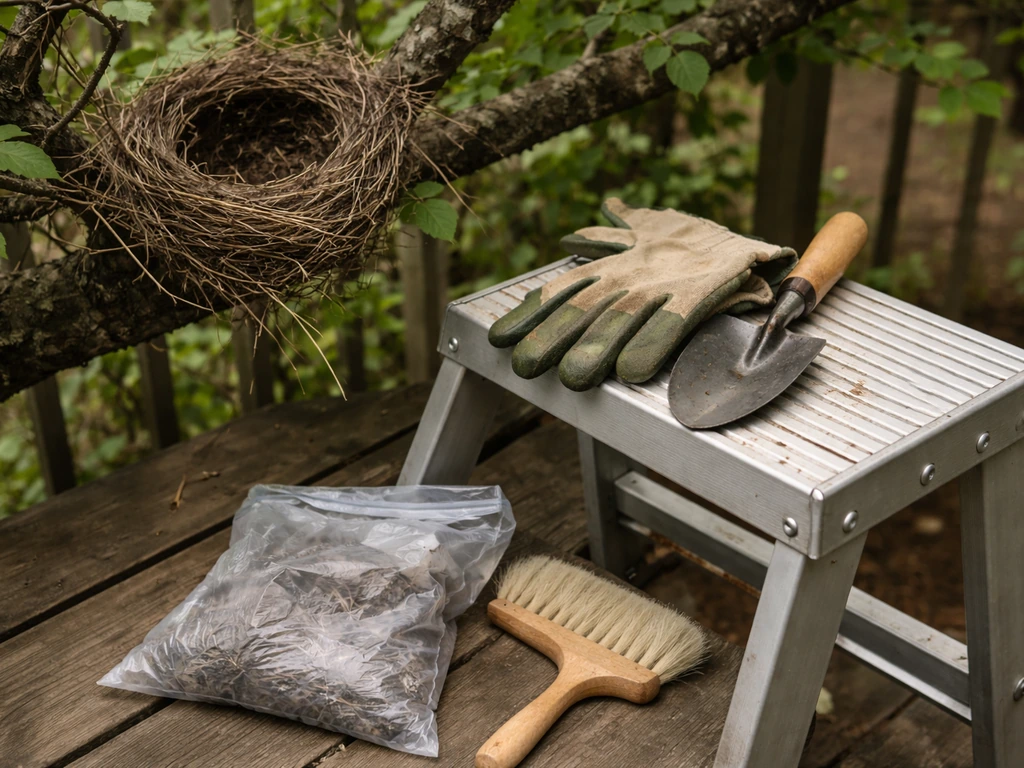
Once birds have left for the season and the nest is clearly abandoned, you have more options. Removing an old, vacated nest is generally permissible outside of active nesting season, though you should check local guidance since some states have their own rules layered on top of federal protections. When removing an old nest, wear gloves and a dust mask: old nest material can harbor mites, lice, and dried droppings. Dispose of it in a sealed bag in the trash, not in compost.
Cleaning up droppings safely
For droppings on foliage, rinse them off with water to prevent leaf burn. For droppings concentrated in container soil, flush the pot thoroughly to dilute salt and nitrogen buildup. If the soil smells bad or looks compacted and crusted, consider repotting after the nesting season with fresh mix. For ground soil in a garden bed, rake and turn the affected area after the birds leave and water well to dilute the nutrient load.
Preventing future nesting in vulnerable spots
If a particular hanging basket or small container plant is getting targeted season after season, the simplest solution is to block access before nesting season starts in spring. Physical exclusion, like covering the plant with bird netting before birds scout locations, is the approach recommended by Oregon DOT and BLM guidance for protecting infrastructure during nesting season. Netting works for plants too, as long as it's fine enough that birds can't get tangled in it.
When to get professional help
Most nest situations don't need an expert, but a few do. Call a certified arborist if you're seeing dead wood in the canopy near the nest, if a large branch has cracked or looks like it could fail, or if you suspect the tree was already declining before the birds arrived. Remember that nests are often built in stressed or hollow wood because birds seek out cavity sites, so the nest may be a symptom of existing tree health problems rather than a cause.
If you're dealing with a colonial nesting situation, repeated year-after-year occupation of a small tree by large birds like herons or cormorants, or if you have a significant population of European starlings or blackbirds creating heavy dropping accumulation, a wildlife management professional or your state's fish and wildlife agency is the right call. Lethal or disruptive management of protected species requires permits, and getting that process wrong creates legal risk for you. If you are wondering about the severity of bird injuries, note that some internal trauma questions like can an air sac rupture kill a bird are a different health angle than plant-damage causes, but it is still a reason to avoid disturbing birds unnecessarily.
For health concerns, if you're finding large accumulations of dried droppings in soil you work in regularly, especially in enclosed or low-airflow areas, that's worth raising with a public health professional. Histoplasma capsulatum can establish in heavily contaminated soil, and while casual garden exposure is low risk for most healthy people, it's not something to dismiss entirely.
The bottom line on nests and plant health
A bird nest is not going to poison your plant, and the folklore around nests being somehow toxic or inherently harmful to vegetation is not supported by evidence. The real risks are physical and accumulative: branch stress from weight, bark damage from certain woodpeckers, and concentrated droppings in confined spaces. All of those are manageable with observation and timing. Most of the time, the honest answer is to leave the nest alone, watch your plant through the season, and deal with any cleanup after the birds have moved on. If you also meant something like a bird fart tornado, note that this page is about nest impacts on plants, while that phenomenon is a separate, more far-fetched wildlife curiosity. A bee sting is generally far more dangerous to birds than typical nest-related risks, but fatalities are still uncommon and depend on the situation can a bee sting kill a bird. Whether or not a rat would kill a bird is a separate question from how nests affect plants, but it can help you think through real risks around an active nesting area would a rat kill a bird. If you are wondering what makes a bird explode, it is usually related to a shockingly different kind of situation than normal nesting damage bird explosion. That approach protects both the plant and the birds, and it keeps you on the right side of federal law.
FAQ
How can I tell if the “bird nest” issue is really the nest, or something else on the plant?
Check whether you see actual nest structure (twigs, grasses, lining) attached to branches versus a patch of fungal growth on mulch or old manure. If you’re seeing tiny “nest-like” cups near the ground and eggs-like shapes are part of the fungus, that’s bird’s nest fungus, which grows on decaying material and does not harm living plants.
Will one season of droppings from a nest harm my plant?
Usually no for a single songbird nest, because the amount is small. It becomes a bigger concern when droppings are repeatedly concentrated under a roosting nest, on small containers, or in a shaded nook where wash-off and dilution are limited.
What should I do if a nest is on a branch that looks like it might snap but it’s still active?
Support the branch from below with a stake or prop tied loosely using soft plant tape or cloth, and avoid touching or repositioning the nest itself. If you notice cracks, dead wood, or the branch is already failing, stop and call an arborist for safer assessment.
Is it safe to prune around a nest to keep it from blocking light?
Pruning while the nest is active is risky legally and practically, since it can count as disturbing “take.” Wait until the nest is clearly abandoned, then prune only the minimum needed, and consider that multiple seasons of heavy buildup can be solved with exclusion rather than repeated cutting.
Does a nest in a hanging basket or window box cause more damage than the same nest in the yard?
Yes, because the root zone is confined. Droppings can raise nitrogen and salts faster in a small volume of soil, so if a basket is repeatedly used, plan to flush the pot after the nesting season or repot later with fresh mix.
Can I move an old abandoned nest immediately if birds left weeks ago?
Not automatically. Nest removal is generally easier after abandonment, but local rules can still apply. Confirm the nest is inactive (no fresh lining, no adults entering, no chicks) and follow local guidance before disposing.
What’s the correct cleanup approach for droppings on leaves and on soil?
For foliage, rinse gently with water to reduce leaf burn risk. For container soil, thoroughly flush to dilute buildup, and if soil looks crusted, smells strongly, or stays compacted, repot with fresh mix after the nesting season.
Can droppings attract insects that then harm my plant?
They can. Heavy, long-term accumulation can encourage pests around the soil surface and in debris. If you see persistent insect activity near the base, focus on removing the droppings after birds leave and improve airflow and watering habits to reduce conditions pests prefer.
Is bird netting an effective way to prevent nesting on the same plant repeatedly?
Often, yes. Install fine bird netting before birds scout in spring, keep it taut, and ensure openings are small enough to prevent tangling. For hanging baskets, netting should allow you to access the plant for watering without leaving gaps birds can exploit.
When should I involve wildlife professionals instead of handling it myself?
If you’re dealing with year-after-year colonial nesting (for example, herons or cormorants), a recurring heavy starling or blackbird problem, or significant dropping accumulation on a small tree or structure. Permits are often required for disruptive or lethal actions involving protected birds.
Should I worry about health risks like Histoplasma from nest droppings?
It matters most with large, long-standing accumulations in places you work regularly, especially enclosed, low-airflow areas. If you’re repeatedly exposed to heavily contaminated soil, raise it with a public health professional, and use basic protection during cleanup (gloves, mask) when handling old materials.
Do all birds create the same risk level for plants?
No. Smaller nests from hummingbirds pose minimal mechanical and chemical risk, while larger, denser nests from herons, raptors, or other heavy builders can weigh several pounds and stress branches. Nest location also matters, deep inside a shrub or over a confined container creates more localized effects.