
The most common animals that destroy bird nests are raccoons, squirrels, cats, rats, crows, blue jays, and snakes. Raccoons are probably the single biggest culprit in most North American backyards, especially for nest boxes. But the right fix depends entirely on which animal you're dealing with, so identification comes first. Some birds that can predate other birds, including pigeons, are also worth identifying before you choose a deterrent bird kills pigeons.
What Animal Destroys Bird Nests? Identify and Stop It

Maya Chen
18 May 2026
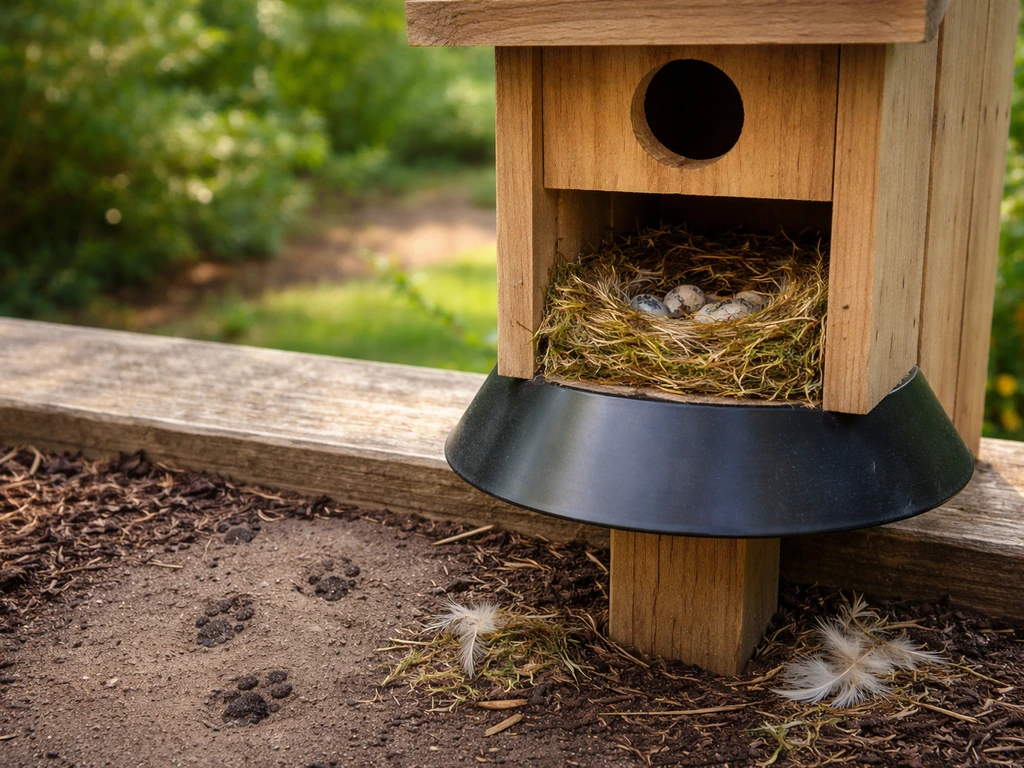
Common nest predators and how each one attacks
Different animals damage nests in very different ways, which is actually useful information. Once you know what each predator does, the clues at the scene start to tell a story.
Raccoons
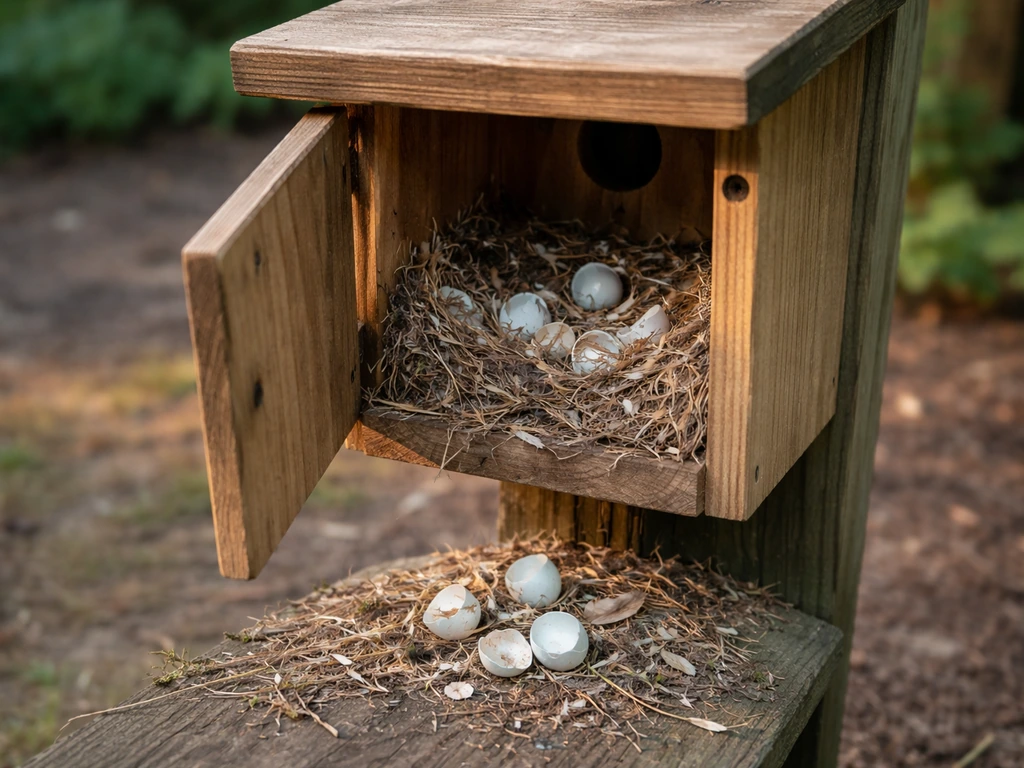
Raccoons are the classic nest-box raider. They reach inside with their hands, pull out eggs or nestlings, and can completely remove eggs or crack and eat them on the spot. They'll tear apart poorly secured nest boxes and leave behind disturbed nest material, cracked shell fragments, and sometimes smeared contents around the entry hole. They're mostly active at dusk, dawn, and overnight. If your bluebird or wood duck box gets hit repeatedly and you find it ransacked in the morning, raccoons are the first thing to suspect.
Squirrels
Gray squirrels are daytime predators, which makes them easier to catch in the act. They'll raid open cup nests and nest boxes, taking eggs or small nestlings. Evidence includes empty nests, missing eggs with no shell debris nearby (they often carry eggs off), and the unmistakable sight of a squirrel repeatedly circling a nest site. Flying squirrels do the same thing but at night, so they're often misidentified as raccoons. Red squirrels have also been documented as nest predators in forest settings.
Rats and mice
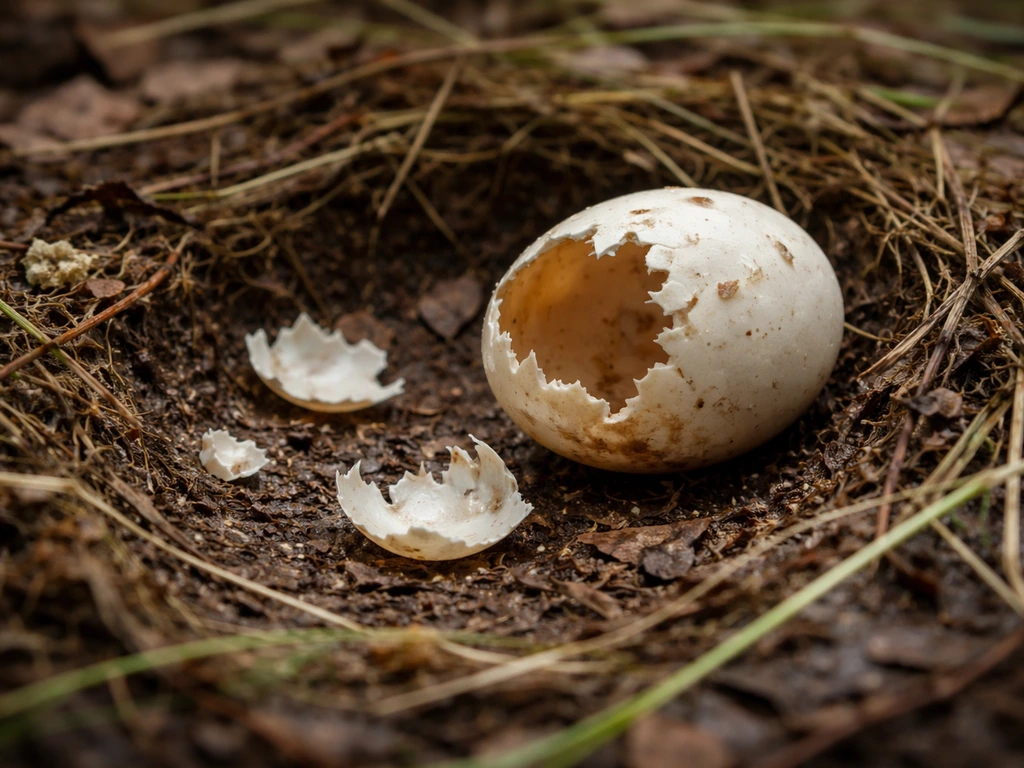
Rats are underestimated nest predators. Research using plasticine eggs has confirmed that rats leave distinctive paired tooth marks on egg remains, typically opened in a consistent pattern. White-footed mice are frequently detected disturbing nests, though actual egg destruction is less commonly confirmed. Rat predation tends to happen at night and is more common in areas where there's a food source nearby, like a poorly secured bird feeder or compost pile.
Crows and blue jays
American crows are documented, frequent nest predators. They eat eggs and nestlings of sparrows, robins, terns, loons, and many other species. Blue jays do the same on a smaller scale. Both are bold, smart, and active during the day, so you may actually see the attack happen. Crow predation often leaves the nest itself intact but emptied, sometimes with one broken egg left behind. You'll typically hear a commotion from the parent birds first.
Snakes
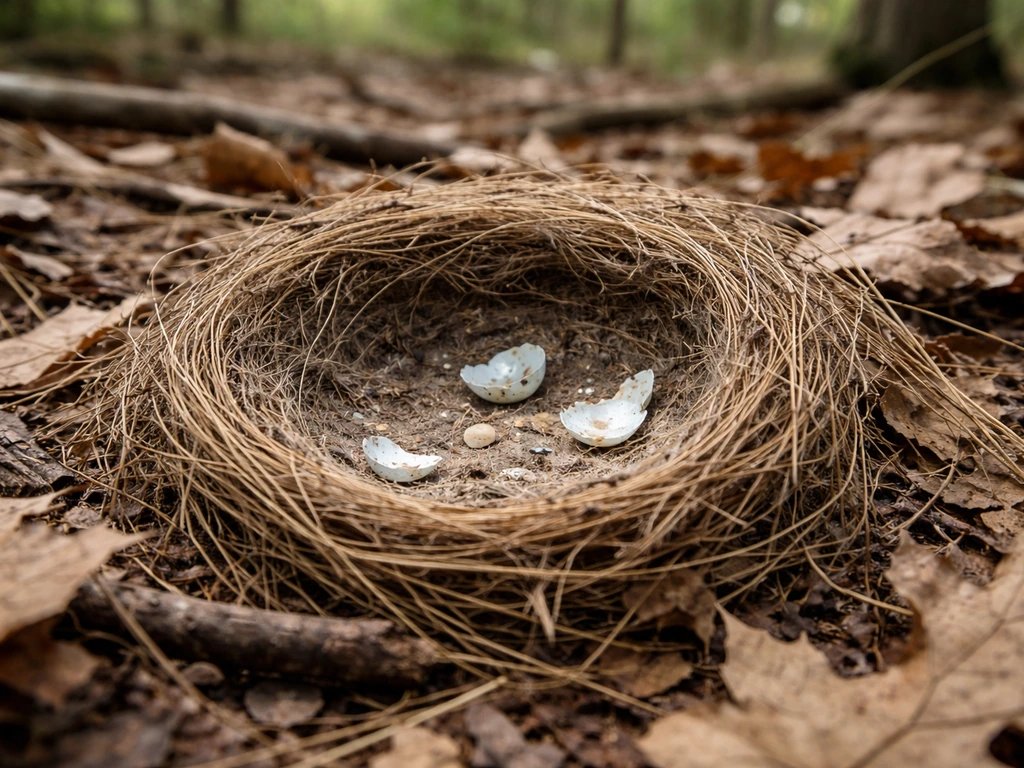
Snakes are stealthy and leave almost no visible evidence. A nest that was full of eggs or nestlings and is now completely empty, with no shell fragments, no blood, and no disturbed nest material, strongly points to a snake. They swallow prey whole. Snakes, in particular, kill by swallowing their prey whole rather than dropping it swallow prey whole. Black rat snakes and corn snakes are especially common nest predators in the eastern US. Interestingly, cavity-nesting birds sometimes line their nests with shed snake skin, a behavior researchers believe may deter mammalian predators, though the effect varies by habitat.
Cats
Both feral and pet cats are highly effective nest predators, especially for ground-nesting birds and low shrub nesters. Cats typically leave feathers, partial remains, or scattered nest material. They're active at dawn, dusk, and at night. A cat attack on a nest box usually shows claw marks around the entry or on the pole, and nestlings may be pulled out rather than eggs stolen.
Opossums and other opportunists
Opossums can raid nests, though they're more often found raiding bird feeders and garbage. Their presence near a nest site, especially at night, shouldn't be ruled out. Other less common but real culprits include minks, weasels, and even larger birds like hawks and owls, which may take nestlings from open nests. One common question is, "what bird are eagles afraid of". Other opportunistic predators like larger birds such as hawks and owls can also take nestlings, which can look like a seagull problem. In rare cases, larger predatory birds can kill smaller birds in their nests, so use identification and evidence before assuming the culprit larger birds like hawks and owls.
How to figure out which animal is actually doing it
You don't have to guess. A few straightforward clues will usually narrow it down to one or two suspects. Work through these in order.
What's missing or left behind?
| Evidence at the nest | Most likely culprit |
|---|---|
| Cracked shells, disturbed nest, smeared contents | Raccoon |
| Empty nest, no shell fragments, nothing else | Snake |
| Eggs missing, no debris (carried off) | Squirrel or crow |
| Broken egg with tooth marks (paired, consistent pattern) | Rat |
| Feathers, partial bodies, scattered nest material | Cat or larger bird |
| Nest completely gone from a low site | Cat, dog, or human disturbance |
| Nestlings missing, eggs untouched | Snake or crow |
What time did it happen?
Timing is one of the most reliable clues. Research using video surveillance has confirmed that different predators hit nests at very different times of day. Raccoons, rats, snakes, and opossums are overwhelmingly nocturnal or crepuscular. Squirrels, crows, and blue jays are daytime raiders. Cats are active across all hours but peak at dawn and dusk. If you find damage in the morning that wasn't there at dusk, you're looking at a nocturnal predator.
Physical evidence: tracks, scat, and damage patterns
Raccoon tracks are unmistakable: five long fingers on both front and rear feet, resembling tiny human hands. Look for them in soft soil or mud near the nest base. Squirrel tracks show four toes in front and five in back in a bounding pattern. Cat tracks are round with retracted claws (usually no claw marks). Snake activity leaves no tracks but may leave a shed skin nearby. Scat near the nest site can help too: raccoon scat is tubular and often contains seeds or berries; rat droppings are small, dark capsules.
Use a camera trap
A basic trail camera or even a motion-activated doorbell camera pointed at the nest will confirm the culprit within one or two nights. Research teams studying nest predation have used photographic methods to conclusively identify predators including raccoons, blue jays, and red squirrels, along with species that disturb nests without fully destroying them. Set the camera before dark, review footage in the morning, and you'll know exactly what you're dealing with. This is the fastest way to stop applying the wrong fix.
Immediate steps you can take today
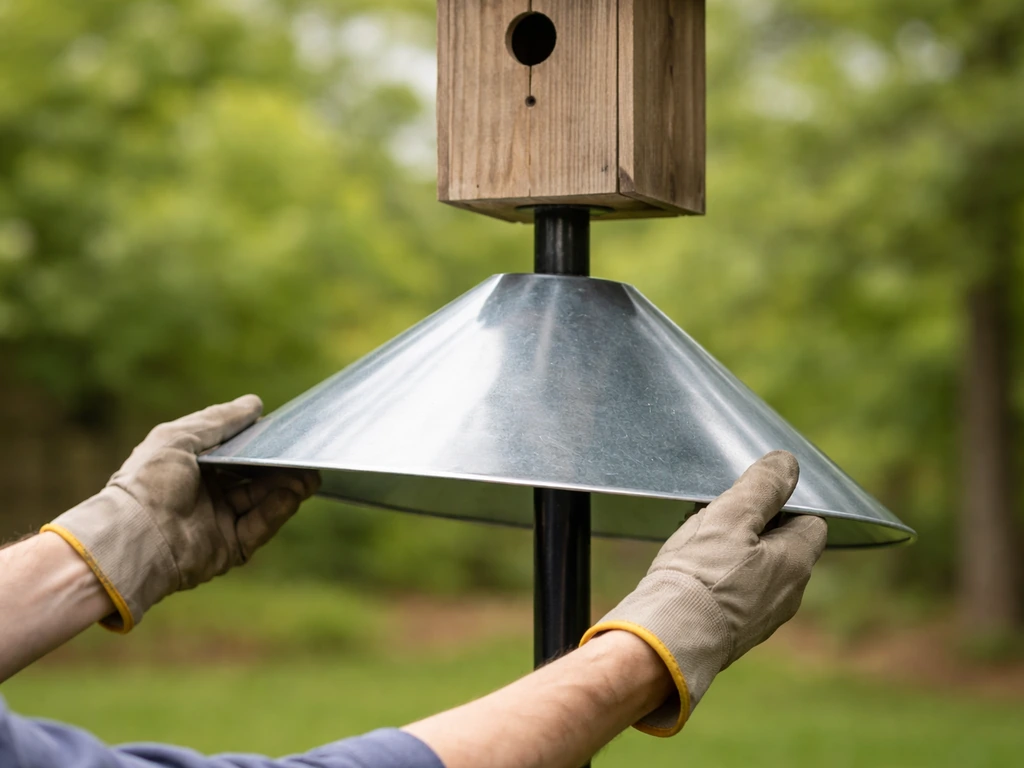
If you've just discovered a raided nest or want to protect one that's currently active, here's what to do right now.
- Install a predator guard baffle on the nest box pole today if you have one available. A conical metal baffle at least 18 inches wide placed about 5 feet up the pole stops raccoons and squirrels in most cases.
- Move pet food and bird feeders away from the nest site. Nearby food sources attract the animals that then find the nest.
- If you have a cat that goes outside, keep it indoors from dusk through mid-morning, covering the highest-risk period for most nocturnal predators and early-morning birds.
- Clear away brush, wood piles, or debris within 10 feet of the nest site. These give predators cover to approach undetected.
- Set up a motion-activated light or sprinkler near the nest if raccoons or cats are suspected. Both are deterred by sudden movement and light.
- Set a trail camera tonight. Even if you can't act on the footage immediately, knowing the predator by tomorrow morning changes everything.
One important note: if there are eggs or live nestlings in the nest right now, do not move or relocate the nest. Under the Migratory Bird Treaty Act, active nests with eggs or dependent young are legally protected. Your job is to protect the nest in place, not to move it.
Humane deterrents and longer-term nest protection
Baffles and predator guards
A stovepipe or cone-shaped metal baffle mounted on the nest box pole is the single most effective long-term solution against raccoons and squirrels. It needs to be at least 18 inches in diameter, positioned so the predator can't reach above or around it. Wobbly or loose baffles work even better because the movement makes them harder to grip. For nest boxes on trees (a poor choice to begin with), a metal collar wrapped around the trunk below the box can help, but tree-mounted boxes are inherently harder to fully protect.
Entry hole reducers and guards
A metal hole guard plate fitted over the entry hole of a nest box prevents raccoons from enlarging the hole and reaching inside. For bluebirds, the standard 1.5-inch entry becomes nearly impossible for a raccoon arm to navigate once surrounded by a metal plate with no extra grip surface. These are inexpensive and take about five minutes to install.
Snake deterrence
Smooth metal poles are harder for snakes to climb than wooden posts. A stovepipe baffle also works against snakes, though they're more persistent climbers than mammals. Keeping grass short around nest poles removes cover that snakes use to approach. There's no reliably effective snake repellent for outdoor use, so physical barriers are your best option.
Motion-activated deterrents
Motion-activated sprinklers work well against cats, raccoons, and squirrels. Ultrasonic repellers have mixed evidence and are not recommended as a primary strategy. A motion-activated light alone can disrupt nocturnal predators enough to push them to easier targets, especially if combined with other measures.
Choosing better nesting locations going forward
If you're installing new nest boxes, pole-mounted boxes in open areas away from trees and fences are consistently the safest. Raccoons and squirrels can jump from nearby surfaces, so keep boxes at least 10 feet from any structure they could leap from. Isolated poles in the middle of a lawn with a baffle installed are the gold standard.
Securing your yard, feeders, and landscaping
A lot of nest predation problems are really food-source problems in disguise. Raccoons, rats, and squirrels often show up because your yard is already feeding them, and the bird nest is just another item on the menu.
- Use squirrel-proof feeders with weight-sensitive ports that close under heavier animals, and bring feeders in at night if raccoons are active in your area.
- Store all pet food indoors. Even a bowl left outside for an hour at dusk can recruit raccoons and opossums to your yard nightly.
- Secure compost bins with a locking lid. Open compost is one of the most reliable raccoon attractants.
- Keep your lawn mowed and reduce dense ground cover near nest sites, which gives predators concealment.
- Remove brush piles and wood stacks near nest boxes, since rats and snakes use these as shelter.
- If you have fruit trees, pick up fallen fruit promptly. It draws rodents and raccoons that then discover nearby nests.
Safety, disease risks, and the legal side of protecting nests
Disease risks when dealing with nest predators
Most of the animals that raid bird nests pose real health risks if you handle them or clean up after them without protection. Raccoons are one of the primary wildlife rabies reservoir species in the United States, alongside skunks, bats, and foxes. A raccoon active in the middle of the day can sometimes (not always) be a sign of illness, but daytime activity alone doesn't confirm rabies. The bigger concern is direct contact. Never handle a raccoon, skunk, or bat with bare hands. If you find a bat near your property, the CDC recommends contacting animal control rather than releasing or handling it yourself, due to rabies exposure risk.
Raccoon scat also carries Baylisascaris procyonis, a roundworm that is dangerous to humans. If you're cleaning a nest box that was raided and has raccoon scat in or around it, wear gloves and a mask, and dispose of material carefully. Rats carry hantavirus and leptospirosis, both transmissible through contact with urine or droppings. These aren't reasons to panic, but they are reasons to use basic protective gear when investigating or cleaning up after a raid.
The legal picture for nest protection
Under the Migratory Bird Treaty Act, it is generally illegal to destroy, move, or interfere with an active nest that contains eggs or chicks, or that is supporting young that still depend on it. This applies to the vast majority of wild bird species in the US. You can protect a nest in place, but you cannot remove it to a more convenient location while it's active. Violating the MBTA carries real penalties.
On the predator side, lethal control of the animals raiding nests also has legal layers. Crows and blue jays, despite being nest predators, are migratory birds and are protected under the same MBTA. You cannot kill them without a federal depredation permit. The USDA APHIS administers a depredation permit process (using form WS-37) for situations where migratory birds are causing documented damage, but casual backyard situations rarely qualify. For mammals like raccoons, squirrels, and rats, state regulations vary. In most states, you can trap and relocate or euthanize nuisance raccoons, but check your state wildlife agency's rules first before setting any traps.
The practical takeaway is this: physical deterrents and habitat management are both the most effective and the most legally straightforward approach. Exclusion beats trapping, and trapping beats any kind of lethal control for most homeowner situations. Focus your energy on making the nest physically inaccessible, and you sidestep most of the legal complexity entirely.
FAQ
If I see a nest completely emptied, does that always mean a snake destroyed it?
Not always. Snakes usually leave a clean nest with little to no disturbed material or shell fragments, but crows and cats can also remove items without obvious “mess,” depending on how the birds fed and whether the predator carried prey away. The fastest way to confirm is to compare timing (night versus day) and set a camera for one evening through the next morning.
What time of day should I check after the damage to figure out the culprit?
Check twice, dusk and morning. Damage discovered in the morning that you can confirm was intact at dusk most often points to nocturnal or crepuscular predators (like raccoons, rats, snakes, or opossums). If you’re only seeing issues after daytime activity, prioritize daytime raiders such as squirrels, crows, and blue jays.
How can I tell the difference between a squirrel raid and a raccoon raid?
Squirrels are more likely to be observed circling the site in daylight and often leave missing eggs with little shell debris because they may carry eggs away. Raccoons more often ransack nest boxes, enlarge weak points, and leave disturbed nest material plus cracked shell fragments near the entry hole. Track patterns also help, squirrel tracks tend to show a bounding motion and four toes in front, five in back.
Do motion-activated sprinklers work for cats and raccoons on every type of nest setup?
They work best when you can aim the spray at the approach path, not just at the box. If the nest is in dense shrubs, mist may miss the animal, and repeated false triggers (like wind or pets) can reduce effectiveness. Position the sensor so it detects the predator’s body, not just falling leaves, and consider combining sprinklers with a proper baffle for mammals that climb.
Are ultrasonic repellers a good first choice for stopping nest predation?
Usually not. The evidence is mixed, and they can fail when predators are already habituated to your yard. If you try one, treat it as a supplement, not the main plan, and still install physical barriers (baffles, collars, or hole guards) that prevent access even when the deterrent stops working.
What should I do if I want to protect a nest that is active right now?
Do not move, relocate, or rebuild the nest once eggs or dependent young are present. Leave the nest in place and focus on preventing further access from nearby predators using barriers that do not require handling the nest itself. If you cannot make the nest safe without disturbing it, wait until the young have fledged and then install the exclusion for the next season.
Can I clean up after a raid immediately and remove the evidence to stop them coming back?
Cleaning can help, but avoid rushing in ways that increase exposure and do not disturb active nesting. For raided nest boxes with possible raccoon or rat contamination, use gloves and a mask, and dispose of debris carefully to reduce disease risk. Also understand that removing debris alone rarely fixes the underlying “access” problem, so install exclusion measures before the next attempt.
Do I need a special permit to deter protected birds, like crows or blue jays?
Yes, for lethal action. Crows and blue jays are protected migratory birds, so killing them without the proper federal depredation permit is illegal. For homeowners, the practical route is exclusion and deterrence, not removal, because the legal pathway for killing is narrow and typically requires documented damage beyond typical backyard situations.
If raccoons show up during the day, does that automatically mean rabies?
No. Daytime activity alone does not confirm rabies, but it can be a risk signal. Do not approach, do not handle, and keep people and pets away. If the animal is acting unusually or you observe concerning behavior, contact animal control for guidance rather than trying to deal with it yourself.
What is the safest camera setup to confirm the predator without stressing the nest?
Mount the camera securely and aim it at the approach area, such as the pole or entry zone, rather than directly reaching into the nest. Set it before dark and review footage in the morning. Minimize visits to the site overnight so you do not inadvertently teach the predator that human presence equals opportunity.
How far should I place nest boxes from structures if raccoons or squirrels are present?
Use the “leap distance” rule: keep boxes at least 10 feet from any surface the predator can jump from, like fences, decks, or tree branches. Even with a baffle, closer placement can allow animals to gain leverage or reach around barriers. In open areas with an isolated pole and a properly sized baffle, you’ll usually get the best results.
Citations
In the U.S., most bird nests are protected under the Migratory Bird Treaty Act (MBTA): it is generally illegal to destroy a nest that has eggs/chicks in it or that contains young still dependent on the nest for survival, except under very limited permitting circumstances.
https://www.fws.gov/story/bird-nests
USGS documents a raccoon approaching a duck nest at night and taking an egg (an example of nocturnal nest-egg predation by raccoons).
https://www.usgs.gov/media/images/raccoon-takes-egg-duck-nest-suisun-marsh
Raccoons are primarily crepuscular (active at dawn and dusk) and nocturnal (active at night), and they commonly raid bird nest boxes (example: bluebird nest boxes not protected with predator guards).
https://portal.ct.gov/deep/wildlife/fact-sheets/raccoon
Connecticut notes that raccoons can be problematic for birds in nest boxes and that daytime activity alone does not necessarily indicate rabies (relevant when deciding whether to contact animal control vs. avoid the area).
https://portal.ct.gov/deep/wildlife/fact-sheets/raccoon
Common evidence of squirrel nest predation includes damaged or empty nests and missing eggs or nestlings, and squirrels are often observed repeatedly near birdhouses/nests.
https://enviroliteracy.org/animals/do-squirrels-go-after-bird-nests/
Maryland DNR states gray squirrels occasionally eat bird eggs or nestlings, and gray squirrels are more readily observed in daytime than nocturnal flying squirrels.
https://dnr.maryland.gov/wildlife/pages/plants_wildlife/squirrels.aspx
Indiana DNR reports gray squirrels do occasionally eat bird eggs or nestlings (confirming squirrels as potential nest predators).
https://www.in.gov/dnr/fish-and-wildlife/wildlife-resources/living-with-wildlife/gray-squirrel/
American crows are described as a frequent nest predator, eating eggs and nestlings of many species (e.g., sparrows, robins, jays, terns, loons, eiders).
https://www.allaboutbirds.org/guide/american_crow/lifehistory
US Forest Service researchers describe using photographic methods to confirm nest predators and list multiple species confirmed as predators on nests, including raccoon, blue jay, chickadee, and red squirrel (showing that even small mammals/birds may be captured on camera methods).
https://research.fs.usda.gov/treesearch/14344
The same US Forest Service work notes that white-footed mice were most commonly detected disturbing nests, but were photographed only once actually destroying an egg (illustrating “disturbing” vs “confirmed egg destruction” as a key evidentiary distinction).
https://research.fs.usda.gov/treesearch/14344
ICWDM notes opossums may create nuisance problems by getting into garbage, bird feeders, and pet food (important for prevention and for interpreting why an opossum may appear near nests).
https://icwdm.org/species/other-mammals/opossums/opossum-damage-identification/
USGS describes predator-specific differences in encounter likelihood with duck nests (e.g., raccoons vs skunks) and notes that habitat features correlated with higher encounter risk could be managed to reduce egg predation.
https://www.usgs.gov/centers/werc/news/research-spotlight-what-habitat-features-make-duck-nests-vulnerable-raccoons-and
An extension article states raccoons may completely remove eggs from nests or eat eggs on the spot, leaving cracked shells and disturbed nest materials; it also notes raccoons can destroy bluebird and wood duck nest boxes.
https://wildlife-damage-management.extension.org/what-are-some-signs-of-raccoon-damage/
A rat nest-predation study reports that predator identity could be inferred from characteristic tooth imprints on plasticine eggs, and that rats often leave characteristic tooth marks on egg remains opened in a consistent manner.
https://pmc.ncbi.nlm.nih.gov/articles/PMC3511072/
All About Birds reports research evidence that cavity-nesting birds can use snake sheds to deter predators from eating eggs and nestlings (supporting that snake-related predation is a real pressure, and birds sometimes counter it).
https://www.allaboutbirds.org/news/why-birds-snakeskin-nests-predators/
Cornell Chronicle reports that researchers collated data on snake-skin use and that this behavior was associated with passerines (perching birds), tying nest defenses to cavity nesting/predator deterrence research.
https://news.cornell.edu/stories/2025/01/cavity-nesting-birds-decorate-snake-skin-deter-predators
A peer-reviewed Animals (MDPI) article reports snake sloughs can reduce nest predation but that the anti-predatory function may vary by habitat and predator species/food resources (important for “repellent/defense” expectations).
https://www.mdpi.com/2076-2615/13/8/1337
A USGS-hosted publication on grassland songbird nest defense to snakes reports that nest defense sometimes did not fully prevent predation: nests defended aggressively/non-aggressively were still consumed to varying degrees, indicating defenses may reduce but not eliminate predation.
https://pubs.usgs.gov/publication/70193345
US Forest Service describes using video surveillance records to understand diel (time-of-day) patterns of nest predation, supporting the “time windows matter” component of camera-based identification.
https://research.fs.usda.gov/treesearch/63834
USGS documents that video surveillance was used to determine diel patterns of nest predation at nests of multiple grassland songbirds, illustrating that different predators/insect/behavioral patterns occur across the day/night cycle.
https://www.usgs.gov/publications/diel-patterns-predation-and-fledging-nests-four-species-grassland-songbirds
The MBTA is described by FWS as prohibiting taking/possessing/transporting migratory birds and “parts, nests, or eggs,” and it specifies that nests with eggs/chicks generally cannot be destroyed without a valid permit.
https://www.fws.gov/story/bird-nests
CDC states rabies post-exposure prophylaxis decisions rely on direct exposure risk; CDC also lists common rabies reservoir animals in the U.S. including raccoons, skunks, bats, and foxes (useful for safety guidance when dealing with mammals near nests).
https://www.cdc.gov/rabies/prevention/index.html
CDC instructs that if you find a bat, contact animal control or your health department to safely capture it for rabies testing and do not release it before speaking with public health experts.
https://www.cdc.gov/rabies/prevention/bats.html?CDC_AAref_Val=https%3A%2F%2Fwww.cdc.gov%2Frabies%2Fbats%2Fcontact%2Fcapture.html
US federal depredation control requires a depredation permit before taking/possessing/transporting migratory birds for depredation control purposes (relevant if a homeowner seeks lawful control options).
https://www.law.cornell.edu/cfr/text/50/21.100
USDA APHIS describes a migratory bird depredation permit process in which a justified request can lead to issuing a form (WS Form 37) for management actions.
https://www.aphis.usda.gov/operational-wildlife-activities/migratory-bird-depredation-permit-process