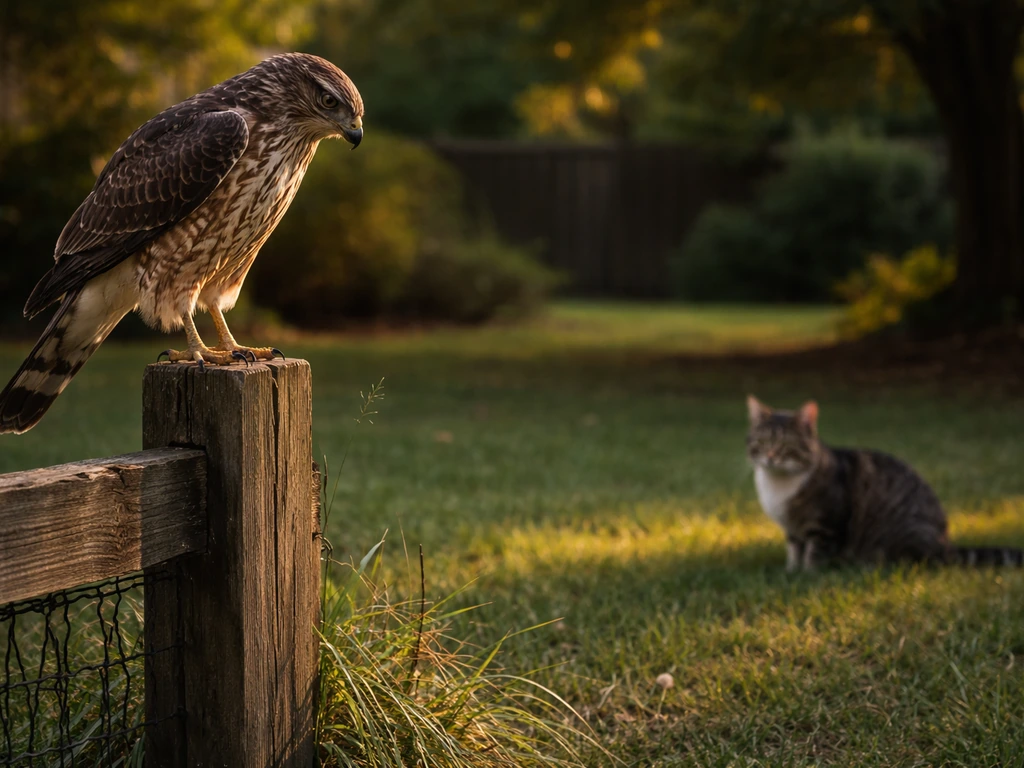
No, a cat cannot kill a bird simply by staring at it. A stare alone delivers no physical force. But that does not mean the stare is harmless, and it definitely does not mean the bird is safe. The stare is almost always the opening move of a predatory sequence, and what comes next can absolutely kill the bird. If your cat is staring at a bird right now, treat it as an emergency and separate them immediately.
Can a Cat Kill a Bird by Staring at It? What to Do

Maya Chen
2 May 2026
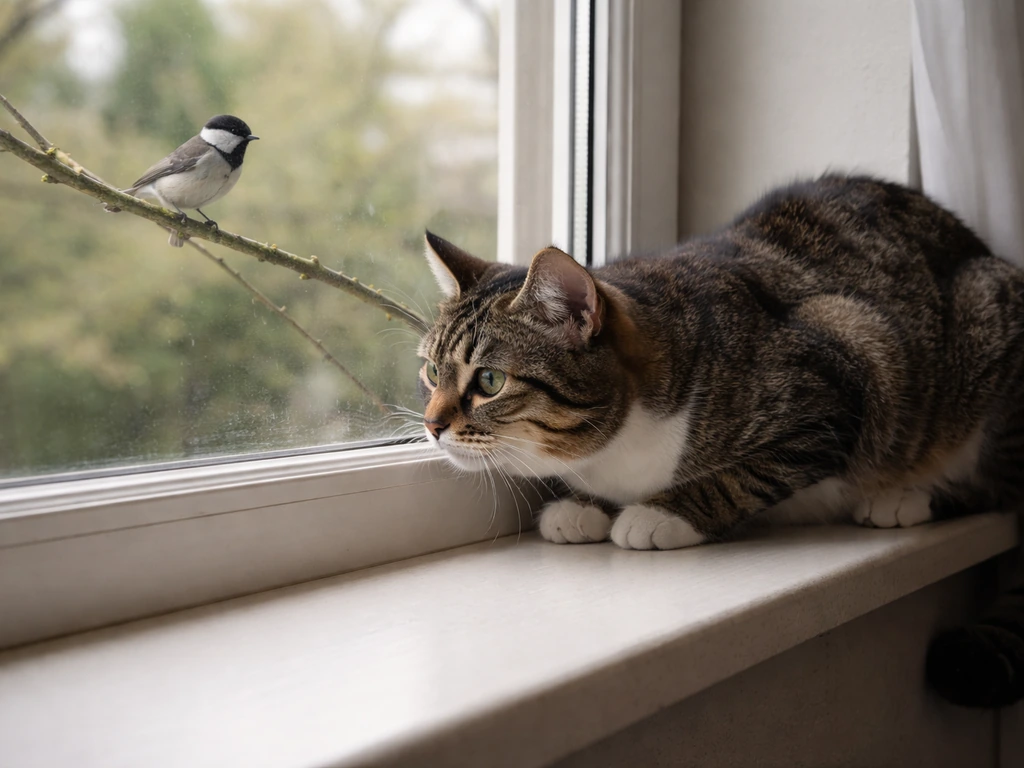
Myth vs reality: does a cat's stare actually harm a bird?
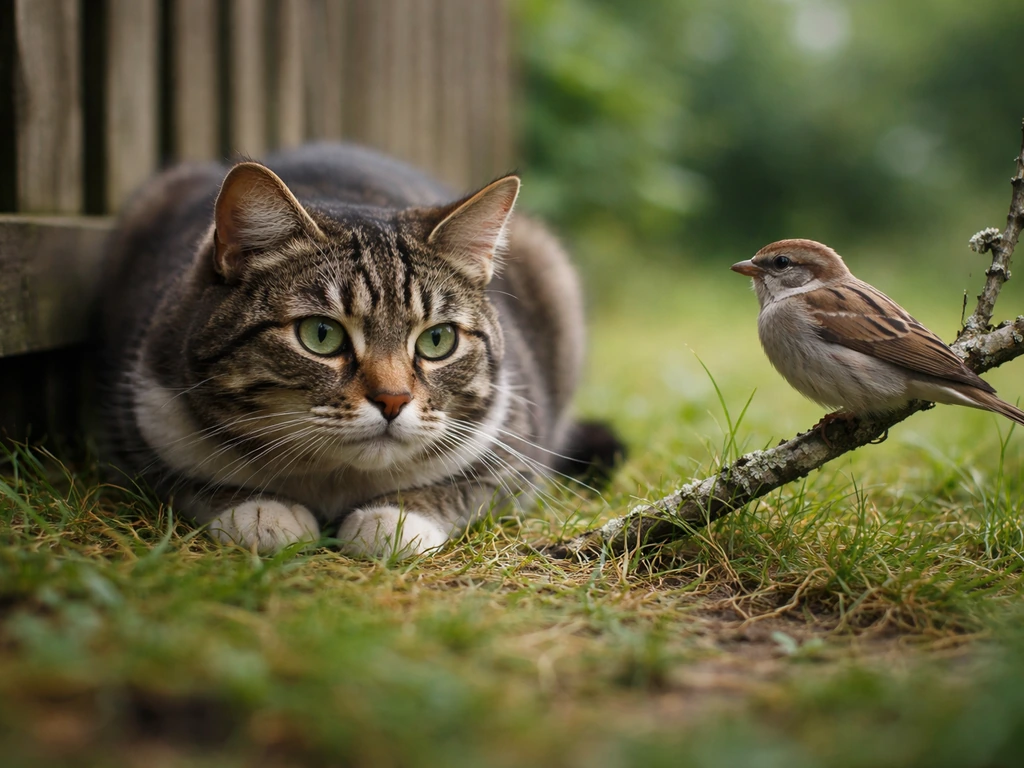
The idea that a cat's gaze can kill a bird is folklore, not biology. There is no mechanism by which eye contact transmits harm. No toxin, no sonic frequency, no electromagnetic field. The myth probably persists because people notice birds freezing in terror when a cat fixes its eyes on them, and a motionless bird looks like one that has been struck. What's actually happening is the bird is responding to a recognized predator cue with a freeze response, which is a survival behavior, not evidence of supernatural harm.
Research on European starlings shows that birds actively monitor feline predators using their sharp lateral vision, and they shift into escape behavior when a cat's gaze is directed at them and sustained. The bird is reading the stare correctly: it signals imminent attack. The stare is dangerous not because of what it is, but because of what it precedes.
What actually makes cats dangerous to birds
Cats are extraordinarily effective predators. A Nature Communications study estimated that free-ranging cats in the contiguous U. A 2013 Nature Communications study estimated that free-ranging cats in the contiguous United States kill about blank" rel="noopener noreferrer">1.3 to 4.0 billion birds per year, with a median estimate of 2.4 billion. S. kill between 1.3 and 4.0 billion birds every year, with a median estimate of 2.4 billion. That number should recalibrate how seriously you take any cat-near-bird situation. All About Birds (Cornell Lab) estimates that cats in the U.S. kill 1.3, 4 billion birds and 6.3, 22.3 billion mammals each year, citing a Nature Communications study blank" rel="noopener noreferrer">FAQ.
The mechanics are efficient and quick. Cats stalk silently, stay low, and close the distance in a burst. According to the National Park Service, once a cat is ready to pounce, it is already too late for the prey animal. The ASPCA notes that cats deliver a killing bite to the back of the neck, severing the spinal cord. It is fast, precise, and often leaves no visible wound on the outside.
Even a cat that does not land a killing bite causes serious injury. Puncture wounds from claws and teeth push bacteria deep into tissue. A bird can look fine and be dying from infection within hours. And you do not need contact for a near-miss to be dangerous: the stress of a chase alone can overwhelm a small bird's system.
One practical note: bell collars are not an effective deterrent. U.S. Fish & Wildlife Service guidance specifically flags the limited benefit of bell collars for protecting birds from cats. Cats learn to move without ringing them, and stealthy ambush means the bell never sounds until it is too late.
Bird stress vs physical injury: what staring can trigger
Even if a cat never touches a bird, prolonged exposure to a predator causes measurable physiological stress. Conservation physiology research documents that predator disturbance in birds produces significant short-term spikes in heart rate. For smaller species or birds that are already sick, injured, or young, that stress response can be dangerous on its own.
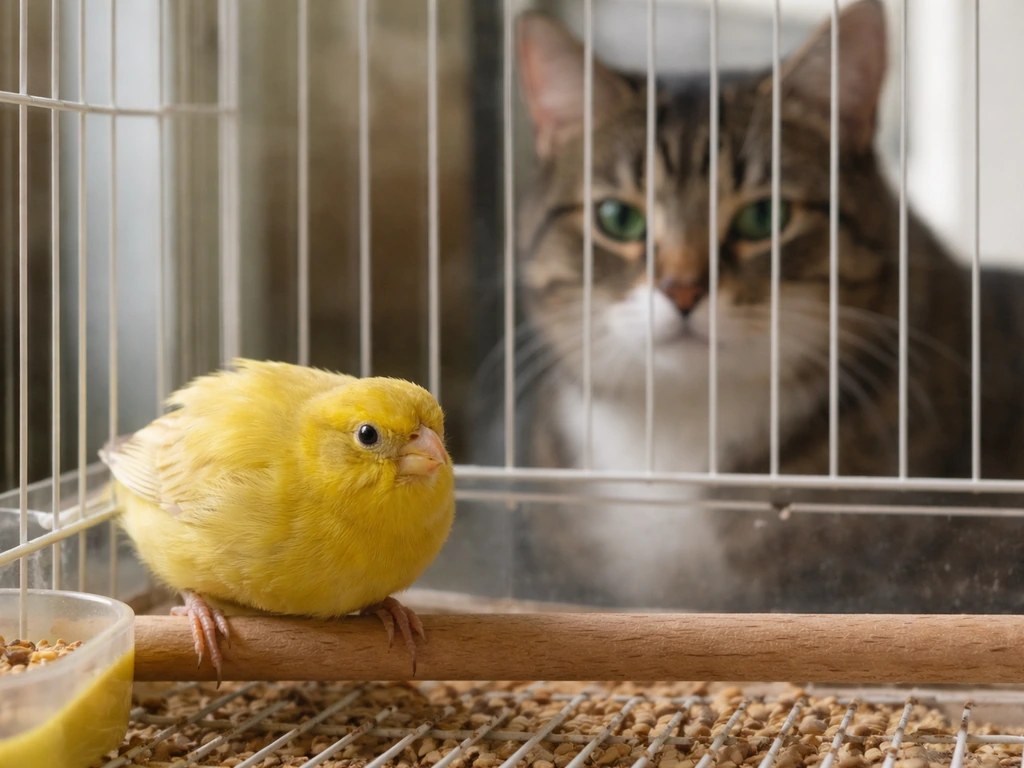
Think about what this looks like in practice. A caged pet bird subjected to a cat repeatedly pressing against the cage, staring and swiping, is not having a neutral experience. It may stop eating, feather-pluck, lose weight, or develop stress-related illness over time. A wild bird pinned down by a sustained stare, frozen in a yard corner, is burning through energy reserves it may not have. The stare itself is not lethal, but the sustained terror absolutely takes a toll. In some birds, night fright can also be dangerous and even lead to death if the stress is severe can night fright kill a bird.
This is worth flagging specifically for pet bird owners: a cat staring at a caged bird through bars is not a safe situation just because the cage is between them. Related topics like whether a cat can harm a bird through a cage are worth understanding separately, but the short version is that stress and physical access are both real risks can a cat kill a bird in a cage. Related topics like whether a cat can harm a bird through a cage are worth understanding separately, but the short version is that stress and physical access are both real risks.
What to do right now if your cat is staring at a bird
Act immediately. Do not wait to see what happens. Here is the sequence to follow:
- Remove the cat from the area first. Do not chase the cat toward the bird. Calmly pick up the cat or lure it away and place it in a separate room, closing the door.
- Check on the bird from a distance before approaching. Is it moving normally? Perched upright? Flying? Or is it on the ground, hunched, or panting?
- If the bird appears uninjured and is a wild bird, give it time and space. A bird that is alert and mobile will often recover and fly off once the threat is gone.
- If the bird is on the ground, unable to fly, or visibly injured, do not leave it. Move to the triage steps below.
- If it is your pet bird, get it away from any sight line of the cat and observe it closely for the next hour for signs of shock or injury.
The most important thing is speed. Every second a cat has access to a bird, the risk escalates from stare to pounce. Do not stop to film it or observe the interaction. Just separate them.
How to prevent future cat and bird incidents
Indoors
The U.S. Fish & Wildlife Service is direct about this: keeping cats indoors is the single most effective way to reduce harm to birds. For pet bird owners, this means never letting a cat and bird share unsupervised space, even briefly. Use separate rooms with closed doors, not just visual barriers. If your cat cannot see the bird's cage, the stress response does not start.
Consider cage placement carefully. A cage on a high shelf does not help if the cat can jump or sit nearby and stare for hours. Place the bird in a room the cat does not have access to at all.
Yards and balconies
If you have outdoor cats or cats with balcony access, the approach shifts to habitat management. Move bird feeders, baths, and nesting boxes well away from surfaces cats can jump from. Ground-feeding birds like sparrows and towhees are especially vulnerable. Avoid dense low shrubs right next to feeders where a cat can hide and ambush.
Physical barriers work better than acoustic or scent deterrents. Roller attachments on fence tops prevent cats from climbing over. Enclosed wire aviaries protect backyard birds completely. The USDA APHIS guidance on free-ranging cats emphasizes that outdoor access is the primary driver of predation, so reducing or eliminating that access is the priority.
Managing outdoor roaming
Outdoor and feral cats present the largest predation risk. If you manage a colony of outdoor cats, Trap-Neuter-Return programs reduce population growth but do not eliminate predation on birds in the area. Advocating for local ordinances that limit free-roaming cats in sensitive bird habitat is a longer-term step, but one that conservation groups actively support.
If the bird is injured or missing: triage and when to call for help
If a bird has been caught by a cat, even briefly, treat it as injured regardless of how it looks. Birds Georgia is clear on this: even seemingly minor cat injuries can be dangerous, because puncture wounds introduce bacteria that cause fatal infections. Do not assume a bird is fine because it is moving.
Here is what to do while you arrange professional help:
- Place the bird gently in a small cardboard box lined with a soft cloth or paper towel. Keep it dark and quiet.
- Do not give the bird food or water. Incorrect feeding can cause aspiration or other harm.
- Keep the box warm but not hot: room temperature is generally fine. Do not use a heating pad directly under the bird.
- Minimize handling. Every time you open the box, you add stress. Tufts Wildlife Clinic recommends covering the bird with a light towel to keep it calm and wings tucked.
- Call a licensed wildlife rehabilitator or avian vet as soon as possible. In many states, only licensed rehabilitators can legally treat native wild birds.
Signs that require urgent help right now, not in a few hours:
- Visible bleeding or open wounds
- Wing drooping on one side
- Labored breathing or open-mouth panting
- The bird cannot stand or keep its head upright
- Seizure-like trembling or complete unresponsiveness
- The bird was actually in a cat's mouth, even briefly
Best Friends Animal Society and Birds Georgia both recommend contacting a licensed wildlife rehabilitator as the primary resource. You can find one through your state's wildlife agency website or through the National Wildlife Rehabilitators Association directory. If you cannot reach a rehabilitator, an avian veterinarian is your next call.
One thing worth understanding in parallel: a bird that survives a cat encounter is not necessarily out of danger. The question of whether a bird can survive a cat bite gets into bacteriology that is worth knowing, because the window for antibiotic treatment in wildlife cases is short. The faster you get professional help, the better the outcome.
The bottom line
A cat's stare alone will not kill a bird. But it is never just a stare. It is the start of a predatory sequence from one of the most effective bird killers in North America. Whether the bird in question is a wild songbird in your yard or a pet parrot in a cage across the room, the right move is always the same: separate them now, assess the bird carefully, and get professional help if there is any doubt. The folklore about lethal gazes is false. The danger from cats is very real.
FAQ
If the bird is just freezing and not flying away, does that mean it is safe?
Yes, but it is not enough to assume safety. Birds can freeze when a cat is focusing on them, and that freeze often sets up the next step, a lunge or pounce. Use separation immediately, then re-check for injury even if the bird seems alert.
Will a window, gate, or partial barrier stop the danger if the cat can still see the bird?
A closed door usually helps if the cat cannot see the bird or smell it at all. A visual barrier like a partial screen or a window can still trigger the predator response because cats and birds read each other’s body posture through glass or gaps.
Are bell collars or loud devices effective at preventing cats from attacking birds?
Bell collars, noise makers, and some scent repellents generally do not stop cat hunting behavior. Cats can learn to move without ringing a bell, and once the cat is close, the noise does not prevent the quick strike.
If my cat never touches the cage, can repeated staring still make my pet bird sick?
For pet birds, treat repeated cat attention as harmful even without physical contact. Ongoing stress can suppress appetite, cause feather damage, and worsen underlying illness, so change the housing setup right away.
What if the cat only swatted at the bird or hovered near it, without a clear bite?
Yes. Any short period of clawing, pinning, chasing, or a near grab can cause internal damage and infection risk, even when there is no obvious wound. Watch for open-mouth breathing, weakness, fluffed posture, abnormal perching, or rapid decline, and seek avian or wildlife care.
Can I tell whether a bird is injured just by looking for visible wounds after a cat encounter?
Not reliably. Cats can deliver a deep bite that is hard to see from the outside, and puncture wounds can become life-threatening quickly due to bacteria. If there is any possibility of a puncture, assume medical risk.
Should I remove the bird to a different spot and observe for a while to see if it is fine?
Don’t try to “test” the bird’s ability to escape by reopening the space. Keep the bird isolated from the cat completely, then get professional guidance if there was contact or intense pursuit. If the bird is a pet, contact an avian veterinarian promptly.
What is the safest way to transport a wild bird after a cat encounter?
If a wild bird was caught or seriously pursued, time matters for treatment decisions. Prepare the bird for transport with minimal handling, use a secure container with air holes, keep it warm but not hot, and contact a licensed wildlife rehabilitator as soon as possible.
Does moving the feeder help if there are still shrubs or ledges where a cat can ambush from?
Yes, and it is an important edge case. A cat can hunt from concealment, so placing a bird feeder far from a cat-friendly hiding spot matters more than just moving it away from the yard center. Avoid dense low shrubs and vertical surfaces from which cats can launch.
Does Trap-Neuter-Return eliminate the bird predation risk from outdoor cats?
If you manage outdoor or colony cats, Trap-Neuter-Return can reduce new kittens and overall population growth, but it does not stop individual cats from preying on birds. The bird safety priority is still restricting hunting access in sensitive areas.
How do I decide when a bird needs urgent help versus just monitoring at home?
For emergency decisions, use a simple rule: any contact, bite, clawing, pinning, or prolonged stalking equals “treat as injured.” Even if the bird recovers briefly, infection or shock can progress, so arrange expert evaluation when any doubt exists.
Next Article
Can a Bird of Prey Take a Cat? Risks and What to Do
Can a raptor take a cat? Compare owls vs hawks, debunk myths, assess risk, and get today actions to protect pets.